

I got into boxing history the way a lot of men my age did: through my father. He talked for years about the night he watched the first Joe Frazier fight on a black-and-white set the size of a breadbox, and I grew up knowing the names Ali, Liston, Frazier, and Foreman the way you know the names of old generals, figures from some war nobody taught you.
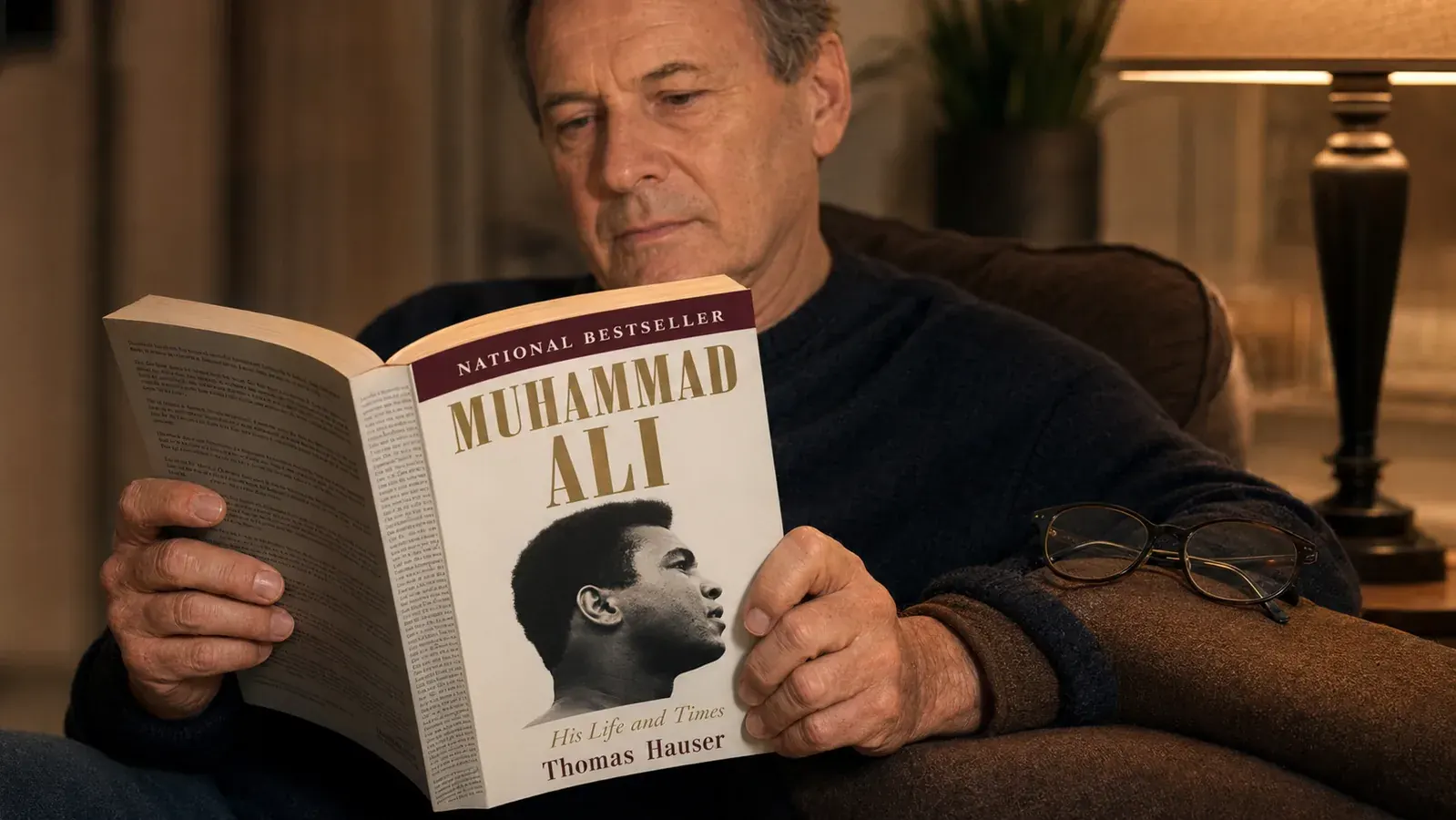
Then I read Thomas Hauser's Muhammad Ali: His Life and Times, and the names stopped being names. It is an oral biography built from interviews with more than two hundred people, so you meet Ali through the men who trained him, the writers who covered him, and the family around him. It taught me that a boxing history book gives a reader a great deal more than a punch-by-punch recap. Here are ten reasons one belongs on your shelf, whether you have watched every heavyweight fight of the last fifty years or none of them.
Start With the Biography Boxing Fans Keep Recommending
If you read one boxing history this year, make it Thomas Hauser's Muhammad Ali: His Life and Times. It is the biography reviewers keep calling definitive, and it reads like a room full of great talkers telling one long story.
Amazon Check Today's Price on Amazon →It drops the famous fights back into the world they happened in
The Rumble in the Jungle was not just a fight. It was 1974 in Zaire, a country still coming out of a coup, with a president spending money he did not have to put two Americans in a ring. Hauser's book sets the whole scene: the politics, the heat, the fighters waiting for weeks while the bout got postponed. Once you read it, even the old footage feels different, because you finally understand what that crowd was holding in the air.
You learn that the man meant more than the belt
Ali refused the draft in 1967 and gave away three and a half years of his prime over a belief he could not put down. The title was stripped, the licenses were pulled, and Hauser shows what that cost in private: the empty arenas, the speeches on college campuses, the friends who drifted away. A biography told through hundreds of voices captures the quiet cost of a public stand, and that is something no highlight film ever shows.
The men in the corner finally get their due
Every famous fighter had someone taping his hands, telling him to sit down, and carrying his bag. Hauser interviewed Angelo Dundee, the cornermen, the sparring partners, and the kids from the Louisville neighborhood who ran errands for the young champion. Those are exactly the voices missing from the fight film, and in this book they are often the best part.
It turns old black-and-white footage into drama
I used to skip old fight footage. The picture wobbled, the gloves looked like sofa cushions, and I had no idea who mattered. Now I know the backstory: the shoulder injury going in, the three years a prime was stolen, the three wars with Joe Frazier that took something out of both men. Once you know what is at stake, the grainy footage becomes a story you cannot look away from.
You see why the heavyweight champion used to be front-page news
For decades the heavyweight title mattered the way a moon shot mattered. Barbershops argued about it, restaurants emptied during the fights, and families gathered around a single screen. Hauser's book is full of those voices, and it makes boxing history read like social history with a fight in the middle. You understand a whole era of America that the sports pages only hinted at.

It gives you a spine for the entire history of the sport
Ali's story runs through the whole modern heavyweight story: Joe Louis as the hero of an older generation, Liston as the monster everybody was afraid of, Frazier and Foreman as the two hardest men of the era. Read one thorough biography like this one, and every other boxing book after it makes more sense. It is the hub that all the other spokes attach to, and it makes the rest of your reading easier.
You collect voices that can never be recorded again
Ali died in 2016, and the men who trained him, fought him, and covered him are mostly gone. An oral history written while they could still talk keeps their voices on the page. That is the quiet gift of this book: reading it feels like sitting in on a conversation with a room full of people who cannot be gathered again.
It makes you the person who knows which book to hand to whom
I buy sports histories as gifts, and this biography taught me the difference between a reader who wants six hundred pages of overlapping voices and a reader who wants one clean story told start to finish. Since finishing it, my gift choices have been right far more often. A book that makes you both generous and accurate is hard to come by.
It shows courage that has nothing to do with violence
The parts that stay with you are not the punches. They are the Thrilla in Manila, Ali barely able to stand after the final bell and telling everyone nearby that it was the closest he had ever come to dying, and the slow quiet years after the gloves came off for good. Hauser follows a man learning to be famous, then learning to be ordinary. For a reader in his late fifties, that second part lands hardest.
It gives you a story to hand to the next generation
Boxing history is at its best when it moves across a table. After a few chapters I called my father and read him a passage about the first Frazier fight, the night he watched on that tiny set, and we talked for an hour. A good history book does that: it turns the past into something you pass along instead of only look at.
What I'd Skip
Be honest with yourself before you buy. The oral format takes patience: hundreds of voices rotate in and out, and if you want a tight linear narrative you may set it down early. It is also a long book, so get it in print. I have read parts on a screen and it does not work; something this big needs a bookmark and a lap. And if you already know every date of Ali's career by heart, you will not be surprised, though you may still be moved. For those readers, a slimmer single story is probably a better fit.
My copy of the book reads like a recorded conversation with a room of men who are mostly gone now, and that is exactly the point.
The Ali Biography Most Fans Will Hand You First
Thomas Hauser spent years interviewing more than two hundred people who knew Muhammad Ali. The result is the book boxing fans keep recommending, and the one I keep gifting. Check today's price and see if it earns a spot on your shelf.
Amazon Check Today's Price on Amazon →