

You can own football history two ways, and they are not the same purchase. There is the story, one life told from the first page to the last until you understand a man and his time the way you understand a character in a novel. And there is the reference, every team and season and player laid out, waiting to be looked up whenever a question comes to mind. I have lived with both kinds of football books for more than thirty years, and hard as it is to admit, they are not even close to the same job. One of them turns my pages; the other mostly holds down a shelf.
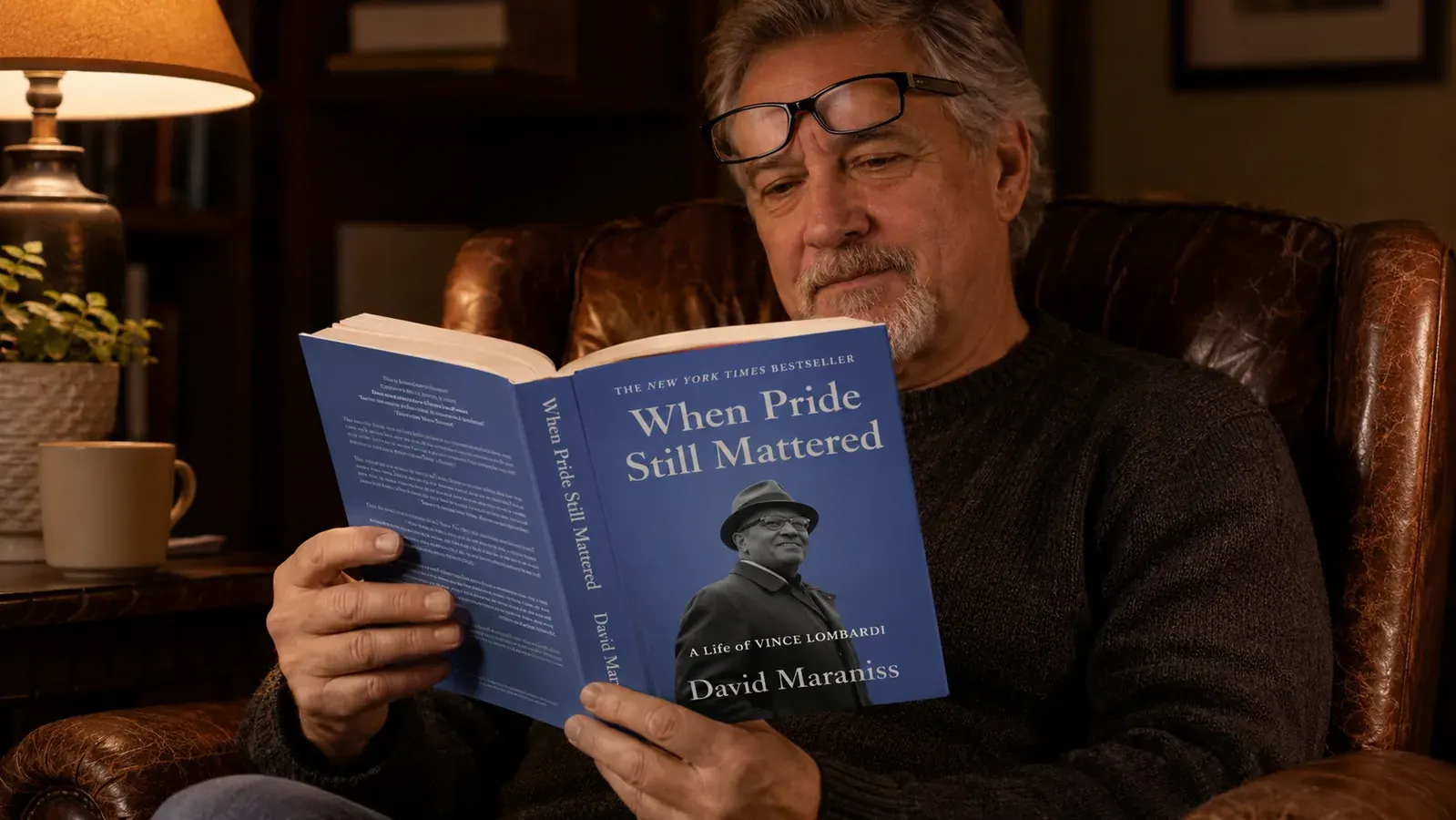
The story kind, done as well as I have found it, is When Pride Still Mattered, David Maraniss's biography of Vince Lombardi. Maraniss is a narrative journalist who spent years on the man, and it shows on every page, in the players' own sentences, in the working-class Wisconsin winters, in the way he lets a single game breathe for ten pages. I first read it in my forties and again this past winter, and I closed it both times more convinced that you meet Lombardi a thousand times better through his life, his doubts, his family, his temper, than you ever will through any list of his achievements.
The reference I am setting against it is the big single-volume NFL encyclopedia, the thousand-page brick that covers the sport from its ragged origins to the modern salary-cap era. It looks magnificent on a shelf, and honestly it is useful. The question I kept coming back to after a season of keeping both kinds near my reading chair is not which one is more impressive to own, it is which one a person actually reads. That is a narrower question, and it favors one of these books far more sharply than people expect.
The Two Ways to Own Football History
Let me set both books out clearly before I argue for one. When Pride Still Mattered is a single sustained narrative, something over five hundred pages in the common edition, devoted entirely to one coach and the league he reshaped. It has an index and a bibliography, because it is a serious work of reporting, but it is built to be read from beginning to end, and it rewards that reading with a point of view that no reference volume can carry. You come out of it understanding not just what Lombardi did but why it mattered.
The encyclopedia, by contrast, is organized to be consulted, not consumed. Its entries are alphabetical or chronological, dense and economical, each one giving you what you need and moving on. It will answer a fact check in seconds and settle a couch argument before the next commercial, and that is genuinely valuable. But it is closer to a tool, a respected and well-made tool, than to a book that keeps you up past midnight. Nobody stays up reading an encyclopedia because they cannot put it down, and I do not mean that as cruelty, it is simply not what the format is for.
Honest confession before the table: When Pride Still Mattered sits on my own reading table, dog-eared, clearly read twice, a couple of corners turned down. The encyclopedia I have reached for, set back, and almost bought at least four times, because every time a fact came up I just looked it up on my phone and got on with my evening. That tension, the hardbound reference against the one great story, is exactly what this comparison exists to sort out, and I want to give the encyclopedia every fair shot it deserves.
| When Pride Still Mattered | Football Encyclopedia | |
|---|---|---|
| Price | One focused hardcover, a reasonable price for a single great book | A thousand-page doorstop that typically costs noticeably more |
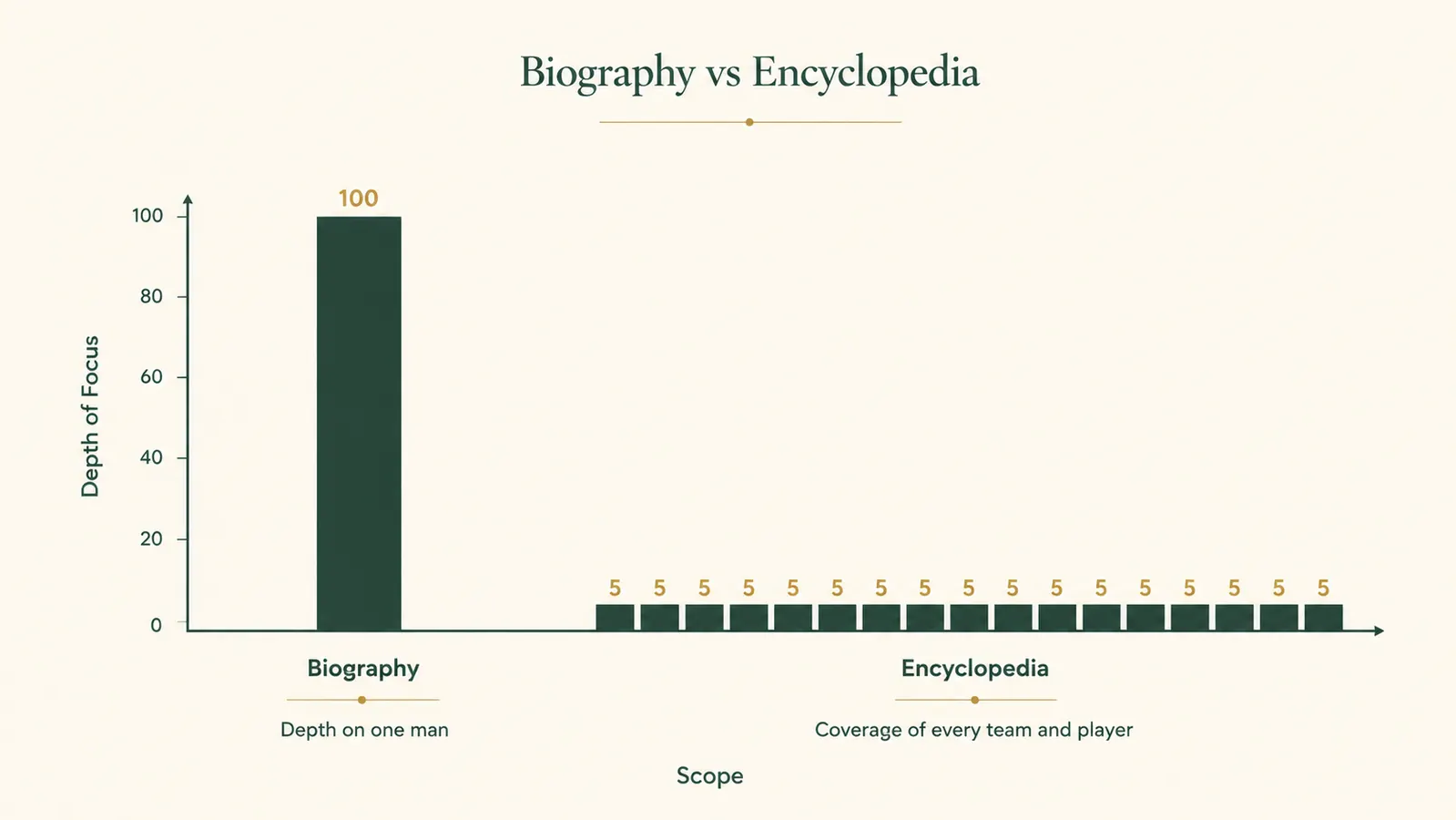
| Depth on one man | The entire book, over five hundred pages, devoted to Lombardi | A few column inches of biography lost inside the league-wide lists |
| Breadth of coverage | One life, one era, told in full | Every team, player, and season in the history of the league |
| How it reads | A flowing narrative you can read cover to cover like a novel | Dense alphabetical entries meant to be dipped into, not read through |
| Reference value | A solid index, but a narrative first | Built to settle arguments and answer fact checks in seconds |
| Best for | The reader who wants one unforgettable story to live in | The fan who wants the whole league catalogued for the couch argument |
What Each Book Actually Does for Your Sunday
This is where the two diverge most practically. The reference makes a better companion to the television, because when a broadcaster names a 1972 playoff game you have never heard of, you can verify it while the commercial plays and feel good about keeping up. That is a real, everyday usefulness, and I want to credit it fully. The story, on the other hand, does its work between games, on a Tuesday night or a long flight, and it teaches you the texture of the sport so that every Sunday afterward has more weight to it than it did before.
In other words, the encyclopedia is synced to the moment you are watching, while the biography is synced to the whole arc of your life as a fan. If you only ever watch games and never think about them after, you may not feel you need the story. But if you have ever watched a game and wished you understood a team's culture, or why a coach makes the calls he makes, or where the leagues traditions actually came from, that is the door the biography opens and the reference simply cannot.
Where When Pride Still Mattered Wins
The biography wins on the deepest dimension there is, which is one man understood. An encyclopedia gives you Lombardi's record in a line and his Packers' roster in a paragraph, but it cannot tell you why he drove those men the way he did, where the son of an Italian butcher from Brooklyn carried his father's disapproval into every practice, or why a team that worshipped him still flinched at his temper. Maraniss gets all of that onto the page because he gives Lombardi the whole book, a freedom a reference volume simply cannot afford.
It is also simply better writing, and I do not say that lightly. Maraniss is a reporter first, which means he lets a scene run. I remember his telling of the Ice Bowl, the 1967 championship played in brutal cold, the way I remember a chapter from a great novel, the frost on a receiver's face, the footing on a frozen field, the steam off the men on the sideline. A reference book, by its very nature, reduces all of that to a score and a date. Between those two, only one has any chance at all of staying with you for years.
There is a further thing worth naming plainly. A good biography gives you the game's logic, the why behind the what. Read Maraniss and you understand how Lombardi's insistence, his absolute commitment to the fundamentals and to the single-minded drill, actually produced the championships, and you carry that understanding into every Sunday you watch after you finish. The encyclopedia records the result of each game; the story teaches you how results get made. For a reader who wants to genuinely understand football, that difference is decisive.
Where the Encyclopedia Wins
Now let me be fair to the reference book, because fairness is the whole point of a comparison like this. It wins on breadth outright, and I gave it that row in the table for a real reason. When my nephew asks me who took the 1963 championship, or my brother wants to settle what happened in the season before either of us was born, the encyclopedia is the tool for the job, right there, in seconds, no screen required. A biography simply cannot do that, no matter how good it is, because it is built to narrow down to one life, not to cover the entire league.
The reference also wins for a certain kind of reader by temperament. Some people like the sheer fact of completeness, knowing the whole league sits between two covers, that nothing has been left out. That feeling of having it all is real, and the encyclopedia honestly delivers it. If your mind works that way, you will not be wrong to own one. I only ask that you go in clear-eyed that it is a tool, not a story. It will answer your questions, and it will very rarely keep you up reading or move you, and those are the two things that make a book precious.
A reference answers every question except the one that matters most, which is why you stayed up reading it.
Who Should Buy Which
Buy When Pride Still Mattered if you want a story, if you read sports books for the people in them, or if you are buying a gift for a reader who already knows the names and now wants to meet the man behind them. It is the book you finish, the one you pass hand to hand through the family, the one you reread on a slow winter. It rewards the long-haul reader, and while it is at it, it explains the modern game better than any almanac ever will.
Buy the encyclopedia if you are the fan who wants the whole league catalogued, who likes settling arguments on paper, who treats reference books as a valued part of the house rather than something to read end to end. For that reader the encyclopedia is not second best, it is exactly right, and I would not talk them out of it. The two books are not really rivals; they serve two different rooms, and knowing which room you actually live in is most of the buying decision.
My honest position, after thirty years of reading football and keeping both kinds near my chair, is that most of us are served far better by the Maraniss book first. That is not a knock on the reference, it is a knock on the idea that more facts means more understanding. When Pride Still Mattered earns its place by being the book people remember, quote, and pass on to the next generation, and that is a higher bar for a sport as full of good stories as football. The reference is a keeper too, but it lives in a different part of your life.
The Verdict, Plainly
Compare them honestly and the answer comes down to reading versus consulting. When you truly want to understand Vince Lombardi, and through him the modern football he helped shape, When Pride Still Mattered is not merely better, it is in a different league entirely. When you want a single fact, the encyclopedia wins, and wins easily, but facts were never really the problem for a reader who loves the game. The problem was always the story, and no reference volume has ever told one worth staying up for.
I will leave you with the one test that settled it for me. On a quiet night, which do you want in your hands, a book that tells you what you already want to know, or a book that shows you something you did not know you were missing? If it is the second, and I suspect it is if you have read this far, then Maraniss is your author and When Pride Still Mattered is your book. The encyclopedia will always be there in the library if you need it. The biography is the one you will actually read.
Meet Lombardi the man, not the statue
David Maraniss took years to write the one football book that reads like a great novel. If you want to understand the coach behind the legend, this is the one. Check today's price on Amazon and let it sit on your shelf the way it has sat on mine.
Amazon Check Today's Price on Amazon →The football book worth reading, not just owning
Maraniss's life of Lombardi is today's price away from being the best football book on your shelf. It was for me. Check the current price on Amazon and see for yourself.
Amazon Check Today's Price on Amazon →