

Everyone who recommends Muhammad Ali: His Life and Times gives you the same one-line pitch, that it is the definitive Ali biography, the standard against which every other book on the man is judged. It is true, and it is exactly why I want to write the review the praise leaves out. Thomas Hauser assembled this book in the late nineteen-eighties by sitting down with Ali and with a great many of the people who shared his life, then built the story out of their voices on tape. What nobody warns you before you buy it is what that choice asks of you as a reader. A book of more than five hundred pages with no single narrator, built on the talk of a man who performed for every audience he ever had, is a different experience from a biography that simply tells you what happened. I read it last winter, a bit every evening, and I came out the other side sure it earns its reputation.
This review is the honest half of that sentence. I am going to walk through what this book is really made of, where you can feel the year it was published, the one practical thing you should do before you open it that nobody mentions, and the exact reader I would hand it to as well as the reader I would steer somewhere else. If you are weighing today's price against your shelf space, you will get a straight answer by the end, and the straight answer is not a simple one.
The Quick Verdict
The most complete Ali book ever assembled, and the one that asks the most of you. Buy it for the voices, and read it with the fights already in your head.
Amazon Check Today's Price →The definitive Ali biography, with every caveat on the table
Every later Ali biography stands in this one's shadow, and readers who love the genre keep circling back to it. It is long, it is oral, and it was built in 1991. If you want the record rather than the legend, check today's price and clear some shelf space.
Amazon Check Today's Price on Amazon →How I've Used It
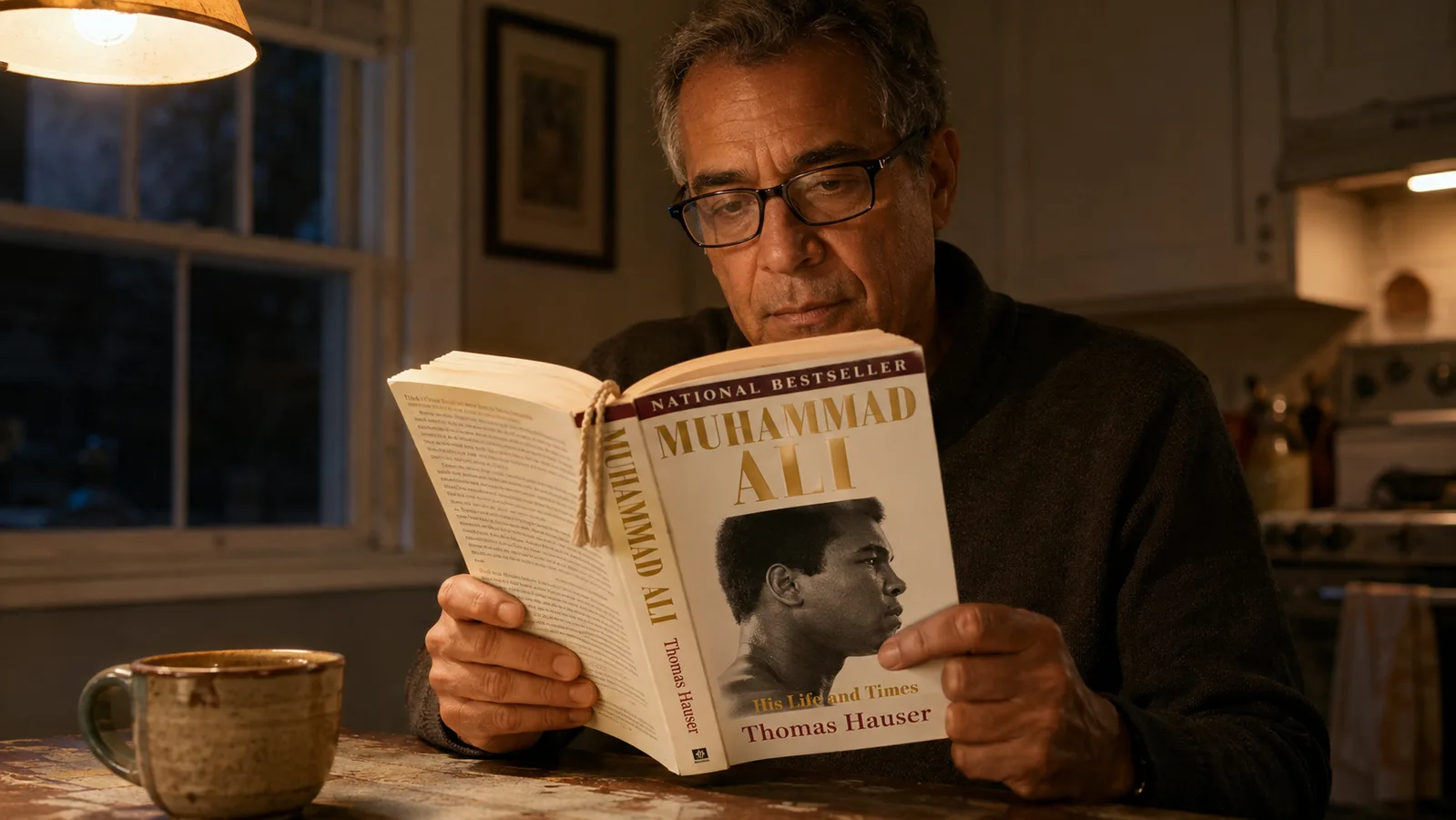
Two things about the physical book that the reviews never mention. It is a thick paperback, dense with print, and it will not lie open on its own. I read lying in bed with the book propped on the mattress and one hand holding the pages flat, and by February that hand had developed a strong opinion about Thomas Hauser. It is a two-hand book, which means you will not be snacking while you read it, and it will not fit in a coat pocket, so it is a home book, not a commute book. I mention all of this because nobody else does, and it shapes every hour you spend with a book you are going to spend a month with.
My method, once I stopped fighting the binding and started working with it, was to read each chapter twice. The first pass I read cold, straight through, the way Hauser arranged it, letting the voices arrive without preparation. The second pass I read with the fight in question playing on a laptop at low volume beside me. That second pass turned out to be the key to the entire book, and I will come back to it in a moment, because I think it is the single most useful thing I can tell you before you start. The book rewards the double read the way good history always does.
The first cover-to-cover read took most of January. I kept a pad of paper on the nightstand and wrote down names I wanted to check later, and by the end of the book the pad was full. Somewhere in the middle I stopped reading to review and started reading to find out what happened next, which is the highest compliment I can pay a history book, because I already knew every result. The book still made me turn pages, and that is not a small thing.
The second read, which I did in the spring, I organized by era instead of by fight. The Louisville boyhood chapters, the exile years, the comeback, the slow years after the ring. Read that way, the book becomes a different creature, less a fight record and more a portrait of a man aging in public, and the voices from each era start to sound like their decade. That is the read I recommend to anyone who already owns the book and thinks they are done with it. The second read is when I stopped reviewing the book and started pressing it on other people.
The Man at the Center Was a Performance
Here is what nobody tells you about an oral history of Muhammad Ali. The man himself was the greatest performer this sport ever produced, and he performed for every audience he ever had, including the ones holding microphones. Hauser did his interviews in the years after the fighting career ended, when Ali had spent two decades learning what people wanted from him and giving it to them in his own voice. So the voice that carries this book is real, it is unmistakable, and it is also a show. Ali had told his own story so many times, to so many reporters, that the stories came out polished, and you can feel him reaching for the line he knew would land.
The most honest moments in the book, to my eye, are the ones where the show drops. They do not come often, and when they do it is usually because someone who knew him before the noise is talking, a man from the old neighborhood, a boyhood friend, a trainer who remembered the shy Louisville kid under the loud one. Hauser is careful with those moments, and the reader learns to watch for them. Learning to tell the show from the man is the real work of reading this book, and it is work the book never tells you you are doing.
That is the paradox at the center of every Ali biography, and this one is more honest about it than most. The performance was not a mask over the man. It was part of the man, the Louisville bragging that became a world stage, and you cannot subtract one from the other. What Hauser gives you is both at once, the show and the glimpses behind it, and he trusts you to sort them out. I came to appreciate that trust, but I would have appreciated a warning that the sorting was part of the assignment.
A Book Published in 1991, Read in 2026
Another thing the blurbs skip is the date. Muhammad Ali: His Life and Times went to press in 1991, and you can feel the year in what the book can and cannot see. Parkinson's had begun to slow Ali's speech, and the interviews themselves must have been a race against that, but the long public chapter that followed, the torch in Atlanta, the humanitarian tours, the way the whole world came to hold him, was still ahead. The book carries the story to the end of the eighties, and a later afterword follows him to the Atlanta flame, but the weight of those final decades, and the grief of watching the decline in real time, is not in these pages the way it sits in a book published after.
Reading it in 2026, I also noticed things a 1991 reader could not have seen. Archives have opened in the thirty-five years since, and later biographers, most notably Jonathan Eig in Ali: A Life, drew on documents and interviews that Hauser could not reach. There are passages here that a newer reader will recognize as the version of events people told on the record at the time, before the fuller record existed. None of that makes this book dishonest. It makes it a document of its moment, which is what the best oral histories are, and it is worth going in knowing that the record has moved since.
The most useful way to think about the date, I have decided, is as a gift. Hauser was there at the last possible moment when Ali could still sit and talk at length, and he brought a microphone. Nobody will ever again interview the sparring partners of the Liston era, or the cornermen in Manila, or the men who worked the draft board rooms, because those men are gone. A 1991 book is the only place their voices survive at all. That alone would earn the book its shelf space, even with its rough edges.
Bring the Fights With You
Now the practical tip I promised. This book will not teach you boxing, and nobody tells you that. Hauser quotes testimony from men who threw and caught punches for a living, and those men do not pause to explain the difference between a jab and a hook, or who Sonny Liston was, or what a cut over the eye means in the fifteenth round. If you come in cold, without the fights in your memory, whole chapters will read like code. Hauser trusts you to know the names and the nights already, because the readers he had in mind always did.
The fix is easy, and it is the most enjoyable part of reading this book. Have the fight on a screen nearby. The chapter on the Liston weigh-in lands completely differently when you have watched the weigh-in, the screaming, the theatrical shaking, and you can see why the men in that room disagreed about what they were watching. The Zaire chapter makes more sense with the rope-a-dope in front of you. The testimony about the Thrilla in Manila becomes almost unbearable when you can see the two men who are talking about it. I read the book twice, and the second time, with the fights playing beside me, was the time it became unforgettable.
One map before you start, because the title implies a shape the book does not quite have. The story is organized by fights, so the social history, the draft, the exile, the Nation of Islam years, sits between the rounds rather than in a section of its own. If you are coming for the nineteen-sixties, know that the exile chapters are the core of it, maybe a fifth of the total, and the rest of the tape is the ring. Go in with that map and the book will not surprise you sideways, and you will find the parts you came for.
What I Liked
- The most complete single-volume record of Ali's life in print, built from firsthand testimony
- Ali's own voice carries it, and it is unmistakable even on the page
- The draft and exile years are handled with real gravity, not as a quick chapter
- Disagreements stay on the page, so it reads as evidence rather than hagiography
- A book you will reread by era, not just once, and the second visit is the better one
Where It Falls Short
- More than five hundred dense pages that will not lie open on their own
- Assembled in 1991, so parts of the record have moved on since
- Assumes you already know the fights; newcomers will want footage or a primer at hand
- No single narrator, so readers who want one calm voice may find the cross-talk tiring
The man at the center of this book performed for every audience he ever had, including the one holding the microphone, and the real work of reading it is learning to tell the show from the man.

Who This Is For
Give this one to a reader who has already watched the big fights more than once and wants what happened around them, the Louisville boyhood, the years in the wilderness, the return, carried by the people who actually lived it. If your instinct as a history reader is to trust testimony over opinion, you are its audience. I also picture it as a gift for an older boxing fan in the family, someone who sat in front of a television for these nights and has been looking for a way to pass the whole era along to a younger generation. Add one more reader to the list, the one who can sit inside a book from 1991 without resenting the view, and you have the whole portrait.
Who Should Skip It
Skip it if what you want is one writer's verdict on who Ali was, because this book hands you testimony and steps back, and five hundred pages of different voices will wear you out if you were hoping for a single calm narrator. That is a fair thing to want, and other books give it to you plainly. Skip it if you are coming to Ali cold and hoped the biography would teach you the sport at the same time, because you will spend too many pages trying to picture the punches. And skip it if a long book that needs a month of evenings feels like a chore, because faster biographies exist and will serve you better. I would not argue with any of those choices. I would simply say to come back to this one when you are ready, because it will still be here.
Two Other Books Worth Your Shelf
If the scale frightens you, do not start here. Ali's own memoir, The Greatest, is one voice and a fast read, and it is the essential companion, because it gives you Ali in his own hand before Hauser lets the room disagree with him. Our comparison of the two covers exactly how they differ, and which order to read them in. The memoir is the version of himself Ali wanted the world to keep. This book is everyone else's version, and the two have never fully agreed, which is the most honest possible description of the man.
Jonathan Eig's Ali: A Life is the modern rival, a narrative biography that moves faster than Hauser and draws on decades of archives. My rule is to read Hauser first and Eig second. Start with the record, then let a later biographer tell you what he thinks it means. Read in that order, the two books do not argue. They complete each other, and your shelf is richer for both.
The book that asks for your evenings, with its caveats on the page
Clear the shelf now, because you will finish this one, lend it out, and probably buy a second copy for whoever borrowed it. It is long, it is from 1991, and it is the closest thing this genre has to a primary document. Check today's price on Amazon.
Amazon Check Today's Price on Amazon →