
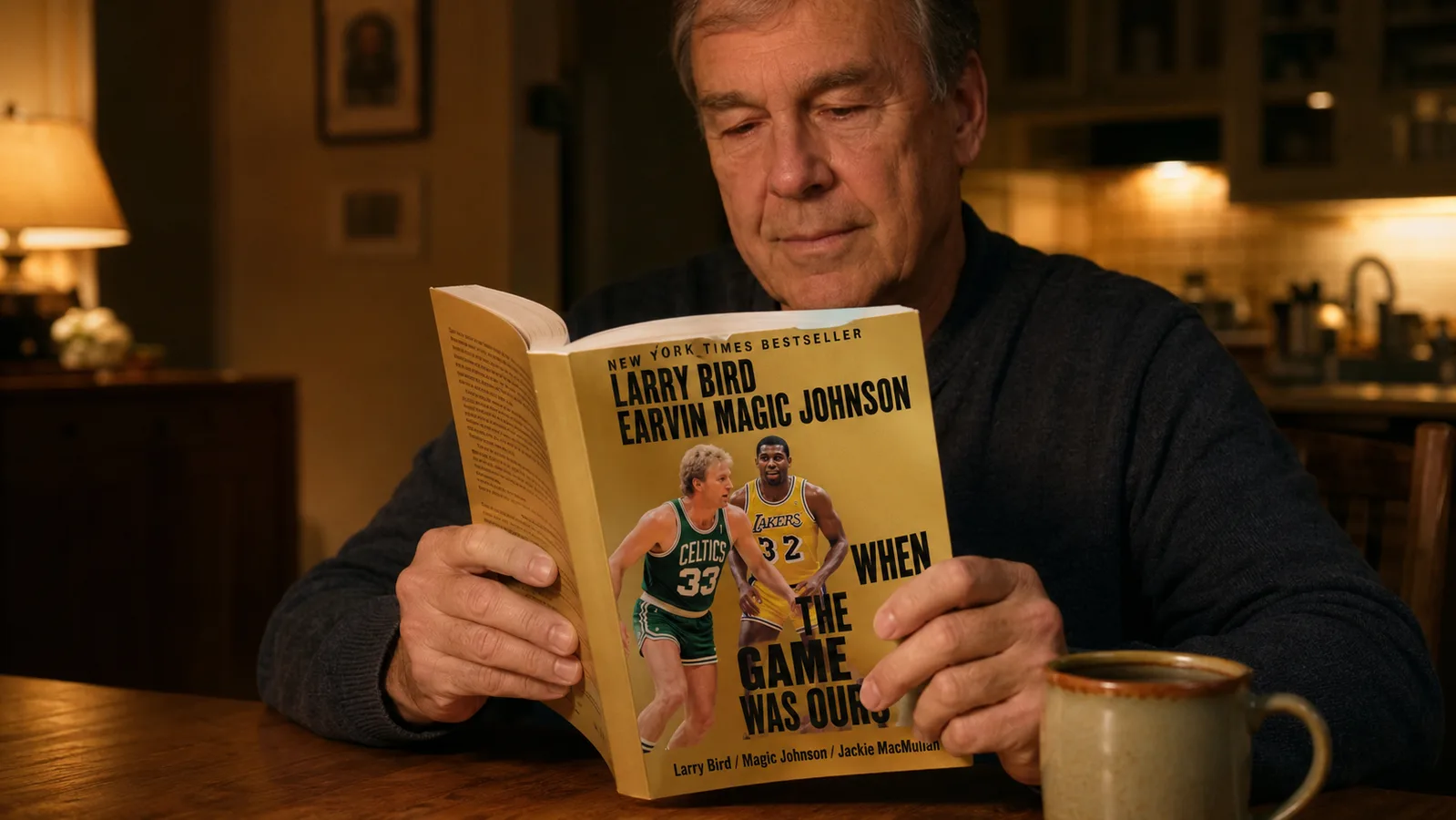
I have reread parts of When The Game Was Ours every NBA season since the year it came out, and somewhere around the third consecutive spring I stopped counting. It was the spring of the 2025 playoffs, I was home with an aching back and a full shelf, and I kept reaching past everything new to turn its opening pages again. I am Gordon Ellis, a reader in my late fifties who has followed basketball since the 1979 championship game, and this memoir, assembled by Jackie MacMullan out of long conversations with Larry Bird and Magic Johnson, is the book I hand anyone who says they want to understand why the 1980s shaped the league.
What I always end up telling people is that Bird and Magic did not simply play basketball. They argued it into a bigger shape. A rivalry that began in that 1979 NCAA final became the reason television decided the league was worth loving, and the friendship that arrived late in both their careers is the reason the record of it now reads like a novel instead of a box score. I want to be honest with you about what this book is, where it shines, and where its own closeness to its subjects leaves gaps. It deserves that, because it is one of the great sports histories of the last twenty years.
That verdict is not nostalgia talking, or not only nostalgia. I write this as someone who buys these books as gifts for his family, watches the tournament every March, and still argues about the 1984 finals with my brother on the phone. The book holds up under that kind of repeated attention. Let me tell you why.
The Quick Verdict
A warm, first-person history of basketball's defining rivalry that reads fast and, for the most part, tells the truth about its heroes. Essential for fans of 1980s NBA history, a little soft for readers who want the grit and the context it leaves out.
Amazon Check Today's Price →Start where the modern NBA began
If one book explains how basketball went from a fading league to a national obsession, it is this one. Grab a copy that sits on the shelf and gets opened every spring, the way mine does.
Amazon Check Today's Price on Amazon →How I've Used It
I am not a person who reads a book once and then shelves it. When The Game Was Ours comes down in my house every March, around the time the tournament starts, because that is exactly where the book begins, with Bird and Magic facing off for the 1979 national title. I read a chapter or two a night and let the memory of that winter settle back in. By the time the actual games start, I can hear their voices in my head while I watch.
I have also bought four copies of this book over the years, and I have given three of them away. My brother, who watched those finals in a basement with me when we were kids, got one on his birthday. A nephew who plays pickup and had no idea why every modern point guard gets compared to Magic got one at Christmas. Each time I handed one over I warned them the same way: read it slow, because it is told in first person and you will want to hear all of it. Gifts like that come back to you later, when they start asking questions about the 1980s.
That is the long-term test, really. A book that survives being a permanent fixture on a shelf, and a gift you keep giving, is doing something right. I keep this one where I can grab it during any playoff run, and I have never once regretted it. The pages now carry my own history in them, the seasons I read them in, the playoff nights that felt like the ones in the book. That is the difference between a book I own and a book I live with.
The Story Behind the Voices
The most surprising thing about the book is how it is built. MacMullan did not narrate this history herself from above. She spent long sessions with Larry Bird and, separately, with Magic Johnson, then stitched their memories into a single first-person telling. You get Bird and Magic describing the same season, the same game, the same 1984 finals, each man from his own side of the floor, often disagreeing about what happened within a few pages of each other.
That shared voice is what makes it work as history. In the 1979 championship, Magic, then a sophomore at Michigan State, beat Bird's Indiana State team in front of an audience the league would not match for years. Neither man ever quite let that first meeting go. Bird carried the sore into the NBA as quietly as he carried everything, and Magic carried the win just as proudly, retelling it often enough that MacMullan lets us see him savor it.
They met again and again in the finals, 1984, 1985 and 1987, the Celtics and the Lakers trading titles while the two of them traded shoves, stares and pointed words. Bird describes Game 5 of the 1984 series the way a man describes a bad day he survived by will. Magic describes 1987, when the Lakers finally beat Boston, the way a man describes finally being believed after a decade of trying.
MacMullan keeps them honest by including the parts that are not flattering. The cheap shot Bird threw in the 1984 finals is in here, described by Bird himself and confirmed by a writer who watched it from the press row. The endless talk, the petty scorekeeping, the way the two of them measured their careers against each other for a full decade, all of it is on the page. That is rare for any superstar tell-all, and it is why I trust the rest of the book.
Why It Reads Like History, Not a Memoir
The reason this belongs on a sports history shelf more than most celebrity books is that Bird and Magic understood, however grudgingly, that they were making history together. They each saw the other as his mirror and his spur. You feel it in every passage where one of them describes the other: Bird calling Magic the most unselfish great player he ever saw, Magic calling Bird the smartest man in the arena. It never quite turns into warmth while they are rivals, and that unresolved tension is what pulls you forward.
There is also real world around them. Kareem Abdul-Jabbar looms over the Lakers chapters, and Walton, McHale and the rest of that Boston front line get their due. The league's struggles before its resurgence, the half-empty arenas, the tape-delayed finals that could not be watched live, all of it shows up in the corners of their memories. A reader who came for the rivalry tends to stay for the era, and that is the mark of genuine history rather than a highlight reel.
What surprised me most on this reread is how much of the modern game the two of them predicted. Magic played all five positions, center included, in his rookie final. Bird spent entire possessions setting screens and moving without the ball. None of that reads as novelty now, because the game caught up to what they were already doing. That gives the book a quality past nostalgia: it explains where the modern NBA came from.
The Friendship That Arrived Late
The book's real subject, though, is not the rivalry. It is the friendship that came after it, and that is what lifts the memoir above the ordinary. When Magic announced in 1991 that he had tested positive for HIV and would be retiring, Bird, who had never been his friend, was among the first to call. The moment when a fierce rival reaches out simply because the man is in trouble is the heart of this book, and both of them return to it again and again.
Bird, who struggled with his own back and would retire not long after, describes that phone call with a plainness that is almost moving. Magic describes what it meant to hear from a man he had spent a decade trying to beat. What began as the most public competition in sports becomes, in the final third of the book, the story of two middle-aged men who finally understood each other. That is not a common arc in basketball history, and it is the reason the book endures. I have read that final third three or four times now, and it still lands the same way. Two men who could barely stand each other, both hurting, both closer to the end of their playing days than the start, found something real to say to each other. That is not basketball trivia. That is the human part of the sport.
Where the Nostalgia Softens the Truth
No honest review can pretend this is a complete history of 1980s basketball, and it does not try to be. It is the story two of its greatest figures want told of themselves, and that colors everything. The physical, punishing underside of the rivalry, the way the 1984 finals nearly turned into a brawl, is here but softened by the fondness of hindsight. A reader who wants the cold, full record of that decade will need another book beside it.
There are also murmurs where a deeper history would dig. The lean seasons after Magic's diagnosis, the locker-room tensions inside those great teams, the rivalries that were not the headline act, all of it stays in the margins. This is a book with a thesis, that two men and their friendship carried the NBA, and nearly everything in it serves that thesis. It is excellent at what it sets out to do and quiet about the rest.
I do not hold that against it. A memoir is allowed to be a memoir. But I watched some of these games live, and the reality was harder and grimier than the nostalgia here. It is worth saying that plainly, because a reader who wants the warts of the era should know where to temper this account. I will also say that MacMullan does not hide the hard facts entirely. She frames them gently, and a reader who wants both the friendly version and the plain version can find them here, one on the surface and the other just under it.
What I Liked
- Genuine first-person history, told by the two men who lived it
- Fast, warm, novel-like read that brings 1980s basketball to life
- Honest enough to include the ugly moments, the cheap shots and the petty spite
- An ideal gift for fans of the era and a strong doorway into NBA history
Where It Falls Short
- Nostalgia softens the hard edges of the decade
- Built around two famous voices, so the wider league stays in the background
- Not a complete record for readers who want the cold, full history
Magic played all five positions, center included, in his rookie final. None of that reads as novelty now, because the game caught up to what they were already doing.
Who This Is For
Buy this one for the person who watched the 1980s, or who wishes they had. It is the book for the fan who starts arguments about whether Bird or Magic was the better player and wants both sides debating in their own head. It is also a thoughtful gift for a younger fan who only knows these names as legends. Reading it, they get the era, the rivalry and the friendship that resolved it, all in the voices of the men who made it. That is a hard combination to find in a single volume. It is also one of those rare sports books that does not require the reader to care about numbers, which is why it keeps working as a gift for people who watch the game and people who just want a good story.
Who Should Skip It
Pass on this one if you want a neutral and comprehensive history of the 1980s NBA, because the wider league stays in the background here. Skip it too if you want an unsparing account of the physical wars inside the decade, because the fondness of hindsight is real and present. And if you have never cared about basketball nostalgia, this book will not change your mind. It is warm, it knows it, and it does its two jobs, telling their story and saying something true about friendship, better than almost anything on the shelf.
The one book about Bird and Magic that belongs on your shelf
Read it slow. It is told in their voices, and you will want to hear all of it. Check today's price on Amazon and set it aside for the next time a playoff run pulls you back in.
Amazon Check Today's Price on Amazon →