
If you watched basketball in the 1980s, you did not watch a league so much as a grudge match between two men. Larry Bird and Magic Johnson met for the first time in the 1979 NCAA championship, when Bird's Indiana State Sycamores faced Magic's Michigan State Spartans, and for the next decade they took turns deciding who owned the NBA. I was in my twenties then, staying up late for West Coast finals and arguing with friends the next morning over coffee. Forty years on, I still reach for books to explain that era to people who only know the modern three-point game. Two of those books come up in every conversation.
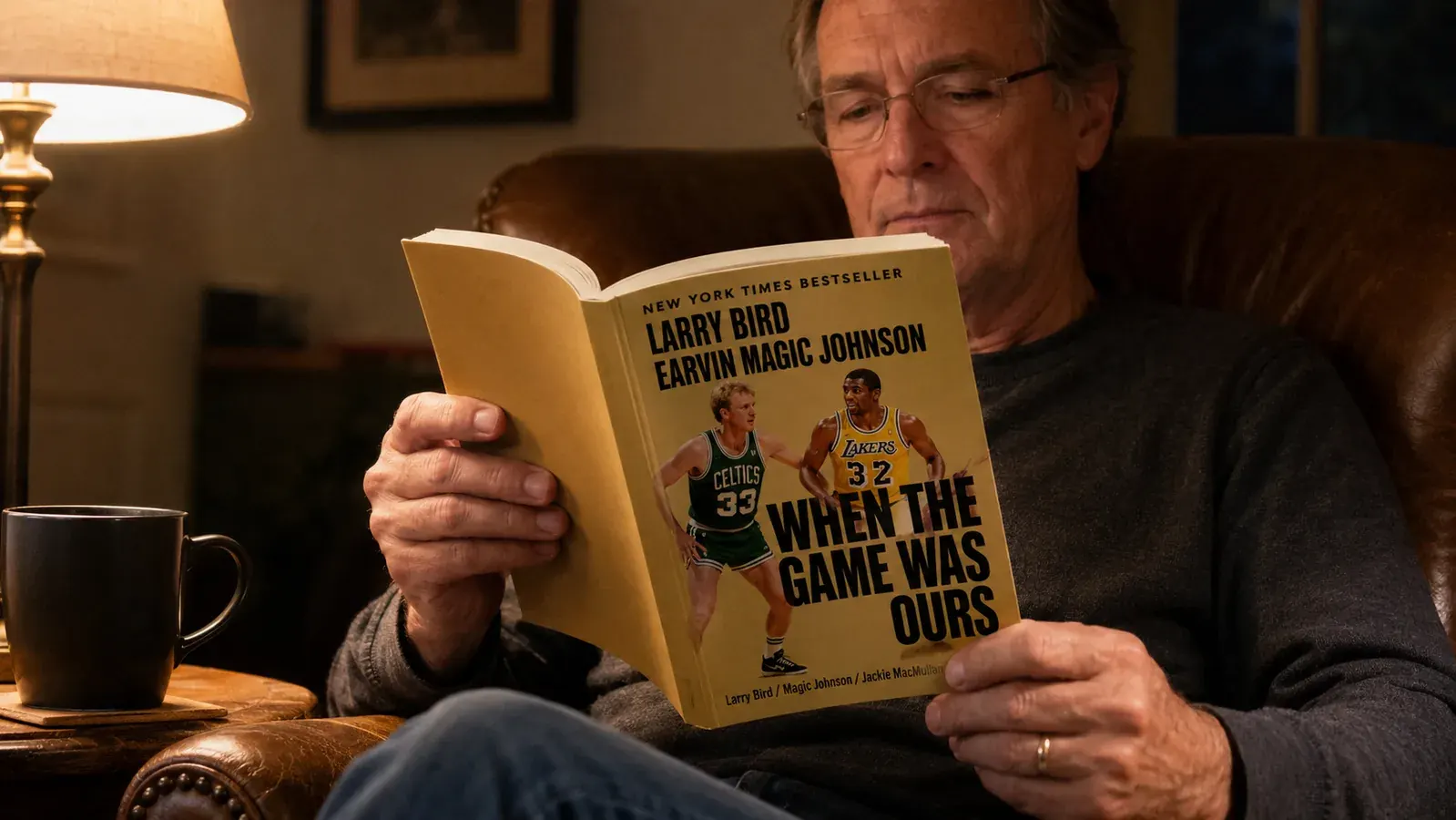
Two books carry the argument better than any highlights reel. When The Game Was Ours, the memoir Bird and Magic wrote with Jackie MacMullan, tells the rivalry from the inside, in the voices of the two men who lived it. Jeff Pearlman's Showtime tells the same decade from the other side, through the Los Angeles Lakers who turned pro basketball into a cultural event. I have read both twice, once in my forties and again last winter, and I keep reaching for them. They do not compete for the same spot on your shelf. This is how I decide which one to press on a friend.
The Two Books, Side by Side
When The Game Was Ours came out in 2009, nearly two decades after the rivalry had cooled, and it reads like a reconciliation. Bird and Magic had spent the 1980s as rivals who respected each other, then became close friends after Magic tested positive for HIV in 1991 and Bird drove to his house to sit with him. MacMullan, a writer who knew both men well, interviewed each one at length and let their voices alternate, chapter to chapter. The book is not a tell-all. It is a settling of accounts between two old competitors who finally understand what they meant to each other.
Showtime, published in 2014, is a different animal. Jeff Pearlman built his reputation on exhaustively reported sports books, and Showtime is the largest of them. He went back to the very beginning, to Jerry Buss buying the Lakers and the arrival of network television money, and built the story out of hundreds of interviews with players, coaches, owners, and assorted hangers-on. Where the memoir is intimate, Showtime is sweeping. Where the memoir is memory, Showtime is journalism.
Reading them together is like hearing the same story from two witnesses who were in the same room and came away with different memories. When The Game Was Ours is warm and reflective, a book you read slowly in the evening. Showtime is loud and fast, a book you read on a flight and then immediately text someone about. That difference in temperature is the difference between the two books, and it is also the difference between Bird and the Lakers.
| When The Game Was Ours | Showtime | |
|---|---|---|
| Perspective | First person, from Bird and Magic themselves, guided by Jackie MacMullan | Third person, a reporter's deep dive into the Lakers organization |
| Emotional intimacy | You hear two men wrestle with friendship, jealousy, and shared triumph | Great anecdotes about everyone, but the two principals stay at arm's length |
| Reporting depth | Memory, checked and shaped by a veteran sportswriter | Hundreds of interviews, the fullest account of the Laker years anywhere |
| Pace and length | A tight memoir you can finish in a weekend | A dense team history that rewards slow reading |
| Best for | Readers who want the heart of the rivalry from the men who made it | Readers who want the whole Laker dynasty, cast included |
Where When The Game Was Ours Wins
The memoir's great strength is that it does not feel ghostwritten. MacMullan interviewed Bird and Magic separately, then wove their memories into alternating voices, and the result reads the way the rivalry actually felt: two proud men orbiting each other, correcting each other, and occasionally finishing each other's sentences. You get the 1984 Finals through Bird's exhausted eyes and the 1985 rematch through Magic's, and the shifting point of view mirrors the series themselves. The intimacy is the whole point, and no amount of reporting can reproduce it.
It is also the better book for understanding why the rivalry mattered in the first place. Showtime assumes you already know the Lakers and the league. When The Game Was Ours spends real time on the moment the NBA almost died, the 1979 title game between Michigan State and Indiana State that drew the largest television audience the sport had ever seen, and on the friendship that started in a parking lot after the draft. For a reader who wants the stakes before the spectacle, the memoir is the clearer way in.
There is a moment near the end of the memoir that I have reread half a dozen times. Magic is describing the 1992 Dream Team, the first time the two of them played together, and how strange it felt to finally be on the same side. Bird talks about watching Magic play after the HIV announcement and crying in his kitchen. That is the entire case for the book in one scene: it lets two guarded men be vulnerable, and it is the closest the rivalry will ever come to a joint autobiography.
Where Showtime Wins
If the memoir is the rivalry's heart, Showtime is its bloodstream. Pearlman interviewed hundreds of people, from Magic's childhood friends in Lansing to the Lakers' longtime owner, and the book is thick with detail no memoir could carry: the deal-making that built the team, the excess of the Forum, the simmering tension between Kareem Abdul-Jabbar and just about everyone else, and the long cast of characters who never made the highlight reel. It is the fuller history, and it is not close.
It is also the more entertaining read for someone who wants the circus as much as the basketball. Pearlman writes with real pace, and his Lakers are a tangle of genius, ego, and appetite. If the reader already knows Bird and Magic and simply wants the wildest story of the decade, Showtime delivers more scenes, more names, more everything. I first read it on a beach vacation and finished it in three days, which for a book of its size is a kind of compliment.
Showtime also wins on sheer volume of story. Pearlman has a gift for the small moment that tells you everything: Kareem refusing to engage with reporters, Pat Riley's transformation from benchwarmer to slick-haired coach, the endless parade of celebrities courtside. There are passages that read like a novel and footnotes that read like gossip, and the mix is exactly right for a team whose whole identity was spectacle. If you want to feel the era's excess, this is the book.
The memoir is the heart of the rivalry. Showtime is its bloodstream.
How They Cover the Same Game
Read them back to back and you will notice something strange: the same moments feel different in each book. The 1984 Finals, which Boston won in seven games, reads as a war of nerves in the memoir, because Bird nearly fell apart in Game 5 and admits it plainly. In Showtime it reads as a Laker collapse, a parade of missed free throws and bad decisions that the organization never quite forgave. Neither book is wrong. They are standing on opposite sides of the same court.
The 1980 Finals shows the gap most clearly. Magic, a rookie, played center in Game 6 after Kareem went down, scored 42 points, and the Lakers won the title. In When The Game Was Ours, Magic remembers the fear underneath the famous night, the sense that he might embarrass himself in front of the whole country. In Showtime, the same night is the founding myth of a dynasty, the moment the Lakers learned they were inevitable. Same game, two truths, and you need both books to see the whole thing.
What the Memoir Skips
To be fair to Showtime, the memoir has real gaps. Because Bird and Magic are telling their own story, the book is light on the wider NBA: little on the other great teams of the era, nothing like the detail Pearlman gives the Laker front office, and almost nothing on the league's business. If you want to know how the NBA went from tape-delayed finals to a global product, When The Game Was Ours will not get you there. It is a portrait of a friendship, not a history of a decade.
Both men are also, understandably, kind to themselves. Bird does not dwell on the fights with his own teammates or the years his back stole from his prime. Magic glosses over the excesses that Showtime covers in gleeful detail. MacMullan pushes, and the book is more honest than most celebrity memoirs, but it is still two legends holding final edit over their own legends. That is the price of the intimacy, and it is worth knowing before you buy.
Start With the Rivalry's Heart
When The Game Was Ours puts you inside the friendship and the fight that saved the NBA. If you are new to the era, read it before Showtime, and you will understand what was really at stake every time those two walked onto the court.
Amazon Check Today's Price on Amazon →Who Should Buy Which
When The Game Was Ours is the right first buy if you care about Bird and Magic as people, if you want the origins of the rivalry rather than the full dynasty, or if you have a friend who loved 1980s basketball and needs a book that reads like a long conversation between two legends. It is the gift I have bought for three different people, and none of them have been disappointed. It is the book I press on anyone who says the old NBA was boring.
Choose Showtime first if the Lakers are the draw, if you want the most complete account of the decade, or if you have already read the memoir and want the wider world behind it. The two books sit well together: the memoir gives you the men, and Showtime gives you the machine they played against. If you can only start one, I would start with Bird and Magic, because their voices are the reason the decade still matters. Save Showtime for when you want the whole story.
Why I Keep Both on the Shelf
At this point I have given away several copies of When The Game Was Ours and one of Showtime, and the pattern is consistent. People who watched the 1980s live come back and say the memoir made them feel the era again. Younger readers, people who came to basketball through the modern game, usually prefer Showtime, because it explains how the modern game got built. The right book depends on where the reader is standing, which is why I keep talking through the choice instead of giving a single answer.
If you put me on the spot, here is my honest guidance. Buy When The Game Was Ours first. It is the shorter, warmer, more human read, and it makes everything else in the era make sense. If it grabs you, and it almost certainly will, then pick up Showtime for the full picture and read them in that order. Start with the men, then meet the machine. Both belong on the shelf of anyone who cares about the game.
The Rivalry That Saved the NBA
When The Game Was Ours is the place to begin. Check the current price, and clear a weekend, because you will not put it down once their voices take over.
Amazon Check Today's Price on Amazon →