
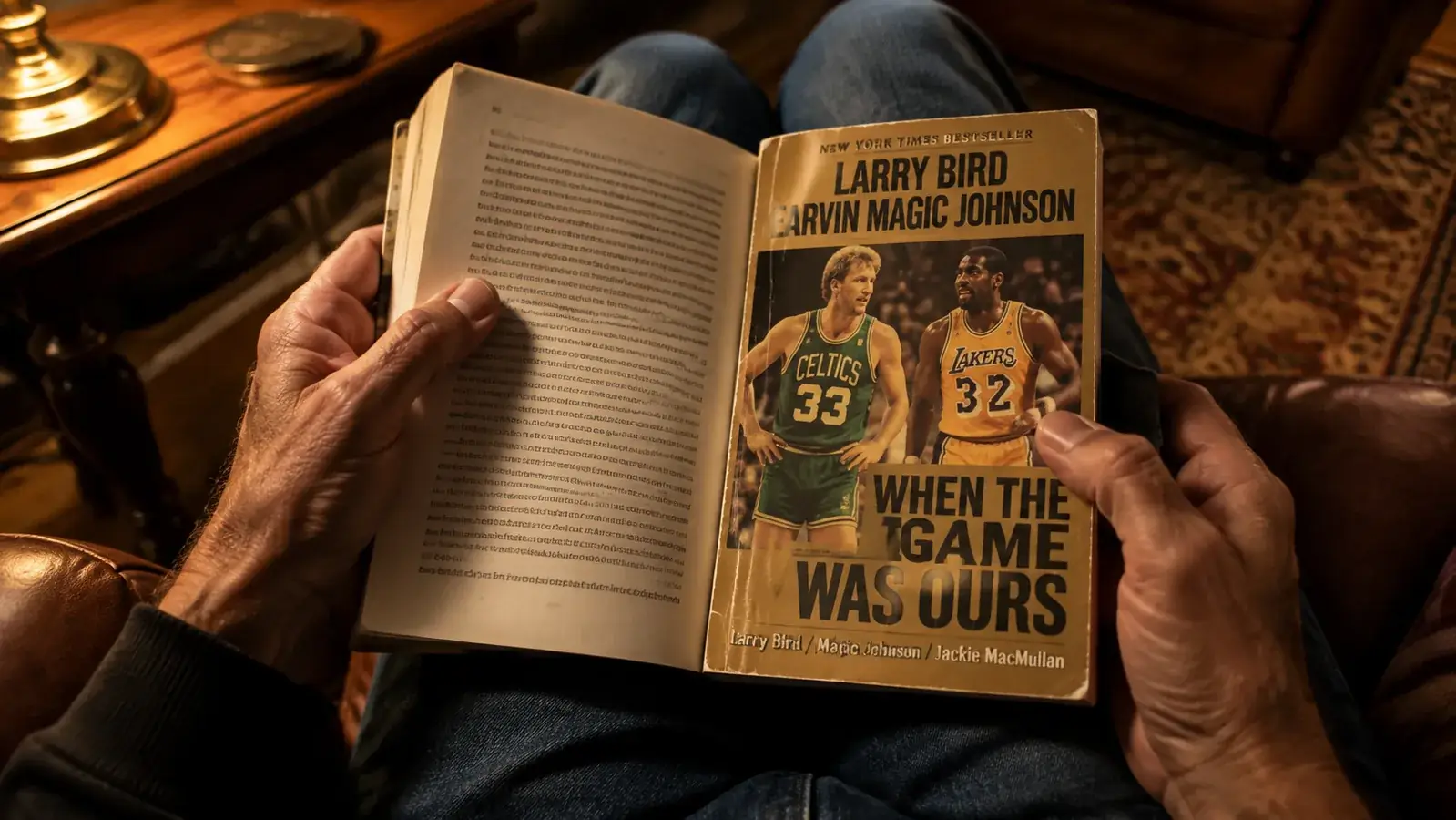
If you have watched the NBA on and off for years but never read a single book of its history, I know exactly where you are getting stuck. I am Gordon Ellis. I followed the league through what most of us agree was its best run, the 1980s, Larry Bird and Magic Johnson trading championships, and I loved every minute of it without ever feeling the need to read about it. The games were the whole story to me back then. Then my son asked what the rivalry was really about, beyond the highlights, and I came up empty. That is when a friend steered me to When The Game Was Ours, the memoir Bird and Magic wrote with the sportswriter Jackie MacMullan, and it turned out to be the friendliest door into the entire history of the professional game.
The mistake most of us make is treating NBA history like a mountain you have to summit all at once. There have been more than seventy championship seasons, dozens of franchises, a thousand memorable players, and the book racks can make it worse, every volume promising to cover the whole league. You do not need any of that to begin. You need one era and two people, and the first book you read should be small enough to hold in your hands while it carries you across a decade. What follows is how I would steer a beginner, the same way I have steered friends and grown children who could not have told you which decade mattered.
Start With the Rivalry That Built the Modern NBA
When The Game Was Ours reads like a conversation between two old rivals, which is exactly what it is, and it holds a 4.6-star average across more than 1,400 reader ratings. In my opinion it is the gentlest on-ramp to NBA history you will find.
Amazon Check Today's Price on Amazon →Why This Book Is the Right Door
Most NBA history books are written by a single author sitting above the league, organizing decades for you like an archivist. That is valuable, but it is not a place to start, because the whole league is too much to love at once. When The Game Was Ours is different. It is told in the actual voices of the two men who defined the era, and because it is a memoir, your only job is to listen to two old friends look back. There is nothing to memorize. There is no starting five to commit to memory. You are just being told a long story by two of the people who lived it.
That intimate format is the thing that unlocks NBA history for a newcomer. Bird and MacMullan and Johnson take turns speaking, and because neither of them ever mastered pretending, you hear both the resentment and the grudging respect. The sportswriter MacMullan did the quiet work of organizing it into chapters, but she had the good sense to stay out of the way. By the time you finish, you will understand the 1980s not as a list of stats but as a genuine human story, which is the only way history ever stays with you. The five steps below use that book as the vehicle.
Step 1: Plant Yourself in One Era
Here is the habit that keeps beginners from quitting. Do not read backward from the present and do not try to cover seventy years. Choose a single era and let it hold all of your attention for your first book or two. I recommend the 1980s, not just because When The Game Was Ours lives there, but because that decade is when the NBA as we know it was built. The league that drew you in, with its rivalries, its marketable stars, and its national broadcasts, essentially starts in those years. Start where the thing you love actually began and the effort feels like discovery rather than duty.
Parking in one era also forgives you everything you do not yet know. Nobody grading you will ask about the 1960s or the 1990s. You have a single decade and a single book, and you can give it your full attention. When I first picked up NBA history, I made the beginner's mistake of jumping around between eras and I kept losing the thread because every chapter assumed a different roster. Settling on the 1980s fixed that instantly. One era, one cast, one story, and the whole thing started to cohere.
Step 2: Meet the Two Men Behind the Era
The 1980s NBA is easiest to understand as a rivalry between two people, and this memoir is built to introduce them to you from scratch. Larry Bird came up from a small Indiana town, a blue-collar forward who played with more will than apparent grace. Magic Johnson came up from a large family in Michigan, all smiles and showmanship, a big man who ran the offense like a point guard. They met in the 1979 national championship and spent the next decade finding increasingly dramatic ways to beat each other. That is the spine of the era, and of the book.
What makes the memoir work is that you are not watching two distant legends from a press box. You are sitting in a room with two men who clearly do not fully like each other and clearly respect each other completely, and they trade the story back and forth. Magic calls Bird, at different moments, his greatest rival and a friend. Bird says the one thing he could not tolerate was losing to this particular man. Reading them together, you stop needing a statistician. You just need to keep turning pages to find out how two such different people turned a whole league into their argument.
Keep a pencil nearby for this step. When Bird or Magic says something that surprises you, underline it. In my copy I have pages and pages of underlined lines, not because I planned a study session but because two men this blunt say things worth keeping. Those margins, not any box score, are what you will remember five years from now, and they are what turn a rented birthday-night memory into a lasting one.
Step 3: Read the Decade, Not the Standings
The easiest way for a beginner to get lost is to chase every championship and every finals series. Resist it. When The Game Was Ours is not really a sports book in that sense. It is a book about friendship, envy, aging, and ambition, and the basketball is the setting that lets those themes breathe. Read it the way you would read any memoir about two complicated people, and let the rivalries arrive as moments rather than as items on a checklist. The season standings will mean almost nothing to you by the last page, and that is a feature, not a flaw.
The book catches both men well past their primes, reflecting on a rivalry that genuinely changed the sport. That backward glance is a gift to a newcomer, because both of them already know how the story turns out and can tell it with perspective. You get to hear a mature Bird explain what a young Bird was doing on the court, and a reflective Magic explain the burden of always having to be charming. That is the human history underneath the dribbling, and it is the layer that makes NBA history worth reading at all.
Step 4: Let the Rivalry Seat You in the Wider League
This is where the book pays you back for finishing it. Once Bird and Magic have given you a home base, every other name in the 1980s hangs off their story and suddenly makes sense. The Celtics and the Lakers were the two anchors, so the supporting cast, the enforcers, the sixth men, the coaches, all of them enter through your new understanding of the two main characters. You will meet them the way you meet the neighbors of two people you just befriended, with context already in place, and that is the friendliest way there is to learn a league.
By the time you close the book, the wider NBA will not feel like a strangers' directory. It will feel like the world your two storytellers moved through, and when you happen on a mention of a team from that decade, you will already have a mental seat in the arena. When you finish and want more, and you probably will, the obvious next reads then fall into place, fuller accounts of the same era and the same two franchises. One favorite book, read well, hands you every other book that comes after it.
Step 5: Turn Reading Into Conversations
The step that makes NBA history stick, and the one most beginners skip, is talking about it. As soon as you finish a chapter or a section, tell someone. I read this book the week my brother-in-law was visiting, and after dinner I recounted one scene between Bird and Magic and we were still arguing about it an hour later. You will be surprised how much of the decade you already half-know from fathers, uncles, and old game highlights, and how quickly those floating fragments lock into place once you share what you read.
Find the person in your life who watched the 1980s. They are everywhere. Ask them who they rooted for and let the book hand you the talking points. In my experience this is the fastest way to feel fluent in the era, because it converts something you read silently into shared history, which is what books were invented for. You will come away able to hold up your end of a conversation that used to intimidate you, and you will never again feel like the person in the room who does not know the story.
You need one era and two people, and the first book you read should be small enough to hold in your hands while it carries you across a decade.
What Else Helps
A few small habits make the whole exercise easier. Read in print rather than on a screen if you can, because you will want to flip back to the earlier pages and meet a name again, and a physical book makes that effortless. Have a browser open while you read, but keep yourself on a short leash. One look at a player you just met is plenty, and thirty minutes down a wiki hole will kill the momentum that a memoir depends on. And read a chapter at a sitting instead of a page at a time, because the two voices work best when you let them trade off a while before you set the book down.
It also helps to bring something of your own to the book. If you have memories of watching the 1980s, even faint ones from a living room television or a cousin's VHS, write them in the margin the way I described. If you have none, that is fine too, because the book does not assume you grew up with it. It assumes only that you are curious about two men who changed a sport. Arrive with that single assumption and the memoir takes care of everything else. You do not need any prior basketball knowledge, only a willingness to sit with two honest storytellers.

Where This Book Asks Something of You
Let me be straight about the tradeoff, because no book is perfect for everyone. Because When The Game Was Ours is told from the two men's own memories, it is not a neutral history of the whole 1980s NBA. The wider league appears through their eyes, and players who matter in other tellings, some of the rival stars, the coaches whose systems defined the era, get less space than they would in a full history. If what you want is a complete chronicle of every franchise, you will want a broader book later. This one trades coverage for intimacy, and that trade is exactly right for a starter, but it is worth naming.
The tone can also run warm where a strict historian might stay cool. Two men remembering their best years are not always neutral narrators, and you will occasionally catch generous accounts of moments another writer might grade harder. That is not a flaw for a newcomer, because it makes the era likable enough to want to learn about, but it is the reason I pair it in my own recommendation with the honest caveat that this is one point of view on the decade, a glorious one. Treat it as a brilliant first book and you will love it. Treat it as the final word on the 1980s and you will shortchange yourself.
The Book That Opened the Whole League to Me
If you have ever watched the NBA and thought you should know more about how it all started, this is your way in. It holds a 4.6-star average across more than 1,400 ratings for a reason, and it reads like a conversation you are lucky to overhear. Pick it up at today's price and start chapter one tonight.
Amazon Check Today's Price on Amazon →