

A book that stays on your shelf for six years and keeps getting pulled down is a different thing from a book you loved once. There is an honesty in the ones that survive a house move, that follow you from a city apartment to a place with room for a real study, that keep their spot next to the histories you actually reread. I have owned Laura Hillenbrand's Seabiscuit for six years, since the summer my sister pressed a copy on me and warned me I was in for the evening. She was right about the evening and wrong only about the scope. Six years later it is not the one-night read I expected. It is the book I hand to other people, the one I reread in slow installments, and the one that has taught me the most about how a good history earns its place.
I came to it about as close to a skeptic as this genre produces. I am a man in my late fifties who reads history most nights in the same leather chair, and horses were never part of my education. I could not have told you what a claiming race was before this book. I had never once placed a bet. The only reason the paperback got past its first ten pages is that Hillenbrand stops trying to sell you on racing almost immediately and starts selling you on people. Once you care about the people, the rest of it arrives, the track politics, the weights, the whole vocabulary of the sport, the way history always arrives for me, on the shoulders of characters who cannot help being worth your time.
The Quick Verdict
A book that gets better the longer it sits on your shelf. The first read is wonderful; the re-reads and the gifting are what make it a permanent part of a home library.
Amazon Check Today's Price →The book that outlived its own movie on my shelf
Most sports histories arrive, get read once, and move on. Seabiscuit is the one I keep reaching for years later and pressing into other hands. Today's price for the Ballantine paperback is small against a book that keeps earning its place.
Amazon Check Today's Price on Amazon →How I've Used It
I want to be precise about what six years of use actually looks like, because it is the part of a long-term review that publishers leave out. I have read Seabiscuit cover to cover twice. The first time was that first summer, mostly in long evenings, and it took a patient three weeks because I kept setting it down to sit with what I had just read. The second full read came about three years later, after I had moved into a house with a proper study and caught myself grabbing the old paperback off the shelf one night when I could not find the new novel I meant to open.
The second read was the more interesting, and it is the single strongest argument for this book's staying power. Knowing how the match race ends, knowing the whole story pays off, cost the book nothing. In fact it gained something. A book you have already finished stops being a hunt for what happens next and becomes a chance to watch the writer work. On the second pass I could see how Hillenbrand sets up a scene pages before she needs it, how the horse's bad leg appears early and gets answered much later, how she lets a throwaway line about Red Pollard's eyes sit so long you almost forget it, and then lands it like a hammer. That is craft you can only see on a re-read. Most sports histories do not survive a second trip. This one is better for it.
In between the two full reads the paperback has earned its keep a dozen other ways. I have reread the match race chapter twice more on its own. I have read the opening pages aloud to a nephew who stayed with us one winter. I have loaned my copy out and had it come back, which is rarer than people think. And I have bought five fresh copies as gifts, which brings me to the part of this story I did not expect.
The Gift Economy of a Long-Term Book
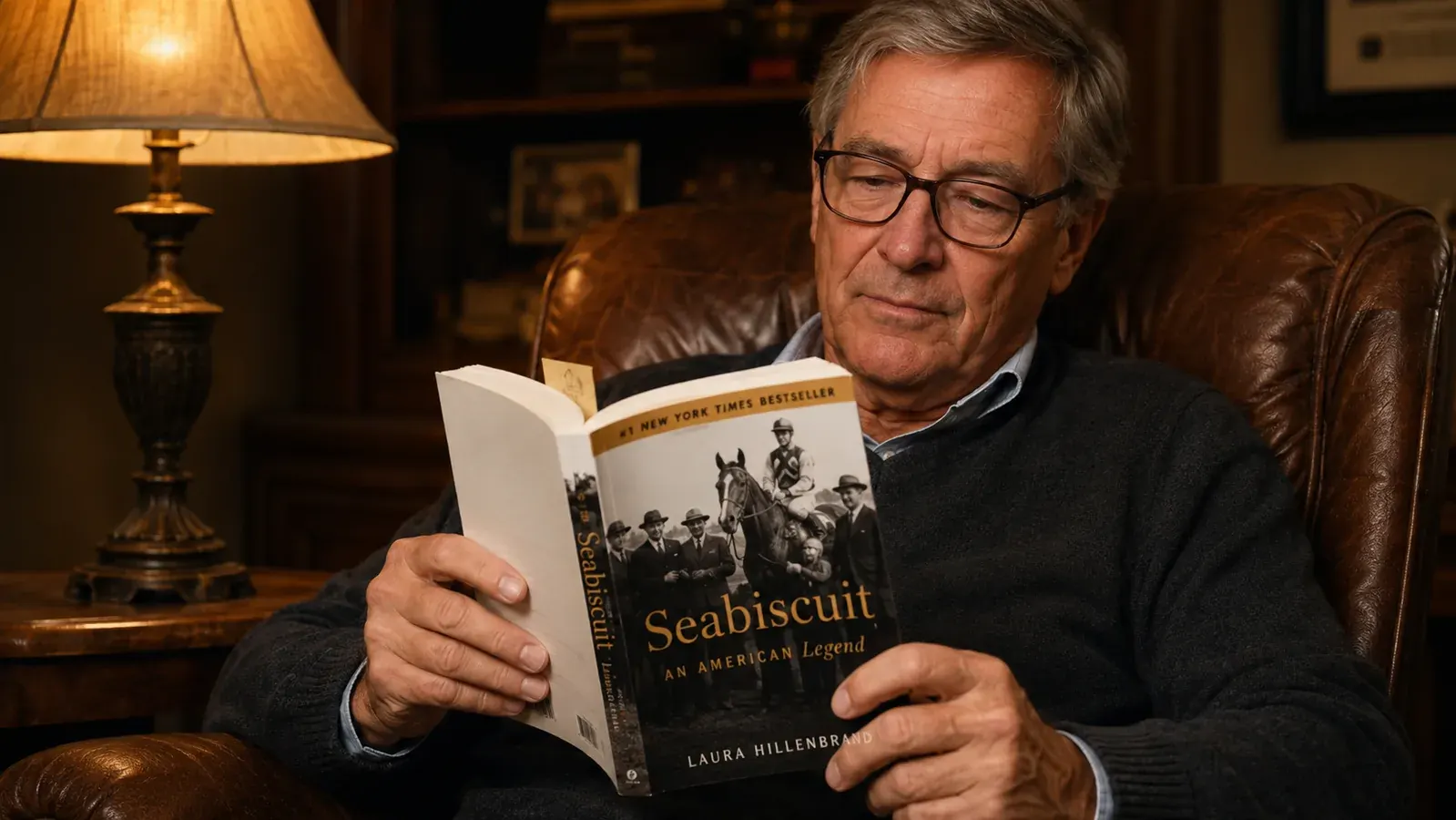
Here is what separates the books that merely get read from the books that get read and then multiply. Six years in, I have bought Seabiscuit five times as a gift, and every single copy has been finished by the person I gave it to. That is a record none of my other favorites can match. I gave one to my brother because he lived through lean years himself and I knew the Depression chapters would land on him one way. I gave one to a niece fresh out of college who had never watched a race and insisted she did not read sports books. She finished it in a weekend and called me to argue about the ending. That is the whole trick of Hillenbrand's book working exactly as designed.
The reason it works as a gift, I have decided, is that it never asks you to be a racing fan. It asks you to be a person who has wanted something against the odds, which at some point is everyone. When a book can be pressed on a retired history teacher, a college student who hates sports, and your own brother who has read almost nothing since high school, and all three finish it, you are not dealing with a niche pleasure. You are dealing with a book that found the universal thread inside a very specific one. That it does this while also being a serious work of sports history is the rare combination that keeps it on my shelf and keeps me buying fresh copies.
I have bought Seabiscuit five times as gifts. Every single person finished it. That has not happened with any other favorite I could name.
Whether It Holds Up as History
A long-term reader has to ask the uncomfortable version of the question, because novelty fades and reputation is not the same as quality. Does Seabiscuit hold up as history, or just as a story? Six years and two reads in, my answer has only grown more confident. The history is the sturdy part. Hillenbrand spent years on the research, and it shows in the honesty of the era. She does not flatter the 1930s. Men lose businesses, families break under the strain, good people go hungry. The small horse and the bruised people around him are presented as one bright thread running through a hard decade, never as proof the decade was fine.
The California backdrop is where the history does its quiet work, and it is the part I appreciate more with every year of my own life. The packing houses, the migrant camps, the radios lit in every kitchen, the racing commissions trying to drag a nearly dead sport back to life. Hillenbrand threads all of it through the story instead of setting it aside in a chapter marked context. That is why the book refuses to go stale. The era is so thoroughly embedded in the narrative that you cannot separate the horse from the decade, and reading it again is like returning to a photograph you keep finding new faces in.
I will be honest about one caveat that has come up over the years, because a reader who loves a book owes the truth. Handfuls of serious turf writers have quibbled with specific details in Hillenbrand's account, the kind of argument that happens whenever someone reconstructs scenes from old newspapers and living memory rather than standing at the rail. None of it has ever moved me off the book, and most of it reads as the normal squabbling of a field that finally got the attention it deserved. But if you are a serious racing scholar, know going in that a masterpiece of narrative history is still a story told with a shaping hand, not a race-meet transcript.
The Physical Book That Earns Shelf Space
There is a practical side to a long-term favorite that no first review mentions, and it deserves its own section. A book you keep for years has to be a book you can live with. The Ballantine Reader's Circle paperback is that book. It is compact enough to hold one-handed in the chair with the lamp on, which my evening reading demands. The paper is thin but not flimsy, the binding has survived six years, a house move, and being shoved into weekend bags, and it still lies open flat on the armrest at a favorite chapter without me holding it down. That sounds like a small thing. It is not. A history you want to reread every few years has to tolerate being put to use, and this one takes it.
My copy carries the physical evidence of its place in my life. A bookmark sits in the match race chapter, half the pages are turned down at favorite moments, and the spine has developed the soft crack only a book opened a hundred times acquires. I do not generally do that to my books. I keep most of them pristine. But Seabiscuit is the one I stopped treating like an object the night I realized it was going to be a permanent resident, and there is a different, older kind of affection in a shelf item that clearly got read.

What Else I Compare It To
On a shelf of sports history, Seabiscuit does not sit alone, and the best way to understand what makes it durable is to set it against the neighbors. Beside the biographies of great racehorses, which are perfectionist stories about animals assembled to win and winning, Seabiscuit is the opposite book, about something made of crooked legs and bad beginnings that wins anyway, and that is the rarer thing to write. Beside Hillenbrand's own later book Unbroken, it is the more American story, tighter and harder to set down, though Unbroken rewards you just as much if you want more of her reporting.
The book I most often hear set against it is Daniel James Brown's The Boys in the Boat, another Depression-era masterpiece, and the comparison is instructive for anyone building a shelf. That one paints on a bigger canvas, nine oarsmen and the 1936 Berlin Olympics behind them. Seabiscuit keeps its eye on one horse and three men and is the more compact, more perfectly built of the two, the one I reach for first when I want the lamp low and a story that ends the right way. They belong next to each other, and neither makes the other unnecessary, but if a single copy is coming home it is always this one.
What I Liked
- Proven to survive re-reading; the second read is genuinely better, not merely tolerated
- A reliable gift across every kind of reader, verified by five finished gifted copies
- Compact Ballantine paperback that holds up to years of chair reading and travel
- History and story fused so thoroughly it does not go stale with time or a known ending
- Roughly 4,700 reader ratings holding a 4.6 average, a long-running consensus that the buzz was earned
Where It Falls Short
- The middle third moves through a run of race-by-race detail that can slow a first-time reader
- Serious racing scholars should know a handful of turf historians have quibbled with specific details
- It rewards slow evenings, not a squeeze-it-into-a-weekend read, if you want the full effect
Who This Is For
Reading it again for this review, six years in, I let it tell me who on your shelf it belongs with, and the list is broad. It is for the history lover who has never once watched a race and believes sports books are closed to them, the reader this one opens the door for. It is for the person whose family always hands them the sports books, who needs one reliable volume to lay on a parent who remembers radios in every kitchen. It is for the reader who guards a small permanent shelf of books they reread and wants to add another, and for anyone who wants to gift a single copy and be almost certain it will be loved and then passed on.
Who Should Skip It
Be honest with yourself before you order it. Skip it if you need a narrative you can finish in one sitting and have no patience for a patient middle. Skip it if you want a writer to tell you how to feel rather than trusting you to feel it, because Hillenbrand keeps her hand off your shoulder and reports the wounds and the wins in the same flat, exact tone. And if you are a strict racing scholar who will grade every named race with a stopwatch and a rulebook, go in knowing it is a story with a shaping hand, not a transcript. For everyone else, the book is patient the way any good history is patient, and it pays the patience back, and it pays it back again on the second read, which is exactly what a book on my shelf for six years has to do.
A book that has earned six years on my shelf and counting
There is a reason this paperback has outlasted most novels I own and kept getting re-gifted forward. It is the rare book that gets better the longer it stays in your life. Check today's price on Amazon and give it the chance to earn its own place.
Amazon Check Today's Price on Amazon →