

If you have seen either movie, you already know how both of these stories end. That is not what keeps readers buying these two books year after year. The movies are too short for the real history: the Depression, the people inside it, the years of hard work that made those famous endings possible. I have read Laura Hillenbrand's Seabiscuit and Daniel James Brown's The Boys in the Boat more than once apiece, late in the evening with the lamp on, and I have bought both as gifts for people in my family. If you are trying to decide which one deserves your shelf first, I can save you the agonizing.
Here is the short answer. Seabiscuit, Hillenbrand's book from 2001, is the purest underdog story in American sport, built around one horse and three men and the racetracks of 1930s California and New York. The Boys in the Boat, Brown's book from 2013, paints on a bigger canvas: nine University of Washington oarsmen, a quietly fierce coach, the working-class Pacific Northwest, and the 1936 Berlin Olympics, where Hitler meant to display racial superiority and a crew of farm boys rowed past his box anyway. Both are narrative history at its finest. The difference is the size of the story and the kind of hope each one offers. Let me walk you through how they really compare.
To be honest, I came to both books late and from opposite directions. I picked up Seabiscuit in the early 2000s because everyone at my office would not stop talking about the movie, and I read The Boys in the Boat about ten years later because my brother, who rows, would not stop talking about the book. Both times I expected to be mildly entertained. Both times I finished the last page sitting very still, the way you do when a book has quietly rearranged something. That is the standard these two are being held to in this comparison, and it is a high one.
How They Compare, Side by Side
| Seabiscuit | Boys in the Boat | |
|---|---|---|
| Price | Ballantine paperback, normally the cheaper of the two at today's listings | A Penguin paperback, usually a few dollars more at today's listings |
| Historical backdrop | Keeps its eye on the horse, the trainer, the owner and the jockey, from California tracks to the big Eastern racecourses | Adds the rise of Hitler, the staging of the 1936 Olympics, and the desperation of the Pacific Northwest in the Great Depression |
| The underdog story | One unimprovable underdog: a crooked-legged, famously lazy horse that everyone had written off, plus a broken-down jockey and a silent trainer nobody else would hire | A fifteen-year-old boy abandoned by his own family, living on windfall blackberries, who rowed his way into history |
| The cast on the page | A small cast you come to know by first name, and every one of them gets a full life in the book | Nine oarsmen plus a coach and a boat builder, a true team story about men learning to move as one |
| Best for a racing fan | The finest horse racing history a racing fan can be handed; every race is told in full and with real love | A great book for almost anyone, but a racing fan will find no racing in it |
| Best for the reader who skips sports books | A horse story that does pull in plenty of non-fans, thanks to Hillenbrand's scenes | The Olympic and Depression history has made this the one book clubs and school reading lists consistently pick |
| The slow spots | Hillenbrand gives you long, patient passages on breeding, betting patterns and track politics | Brown gives you long, patient passages on oar technique, boat building and the rhythm of a stroke |
Where Seabiscuit Wins
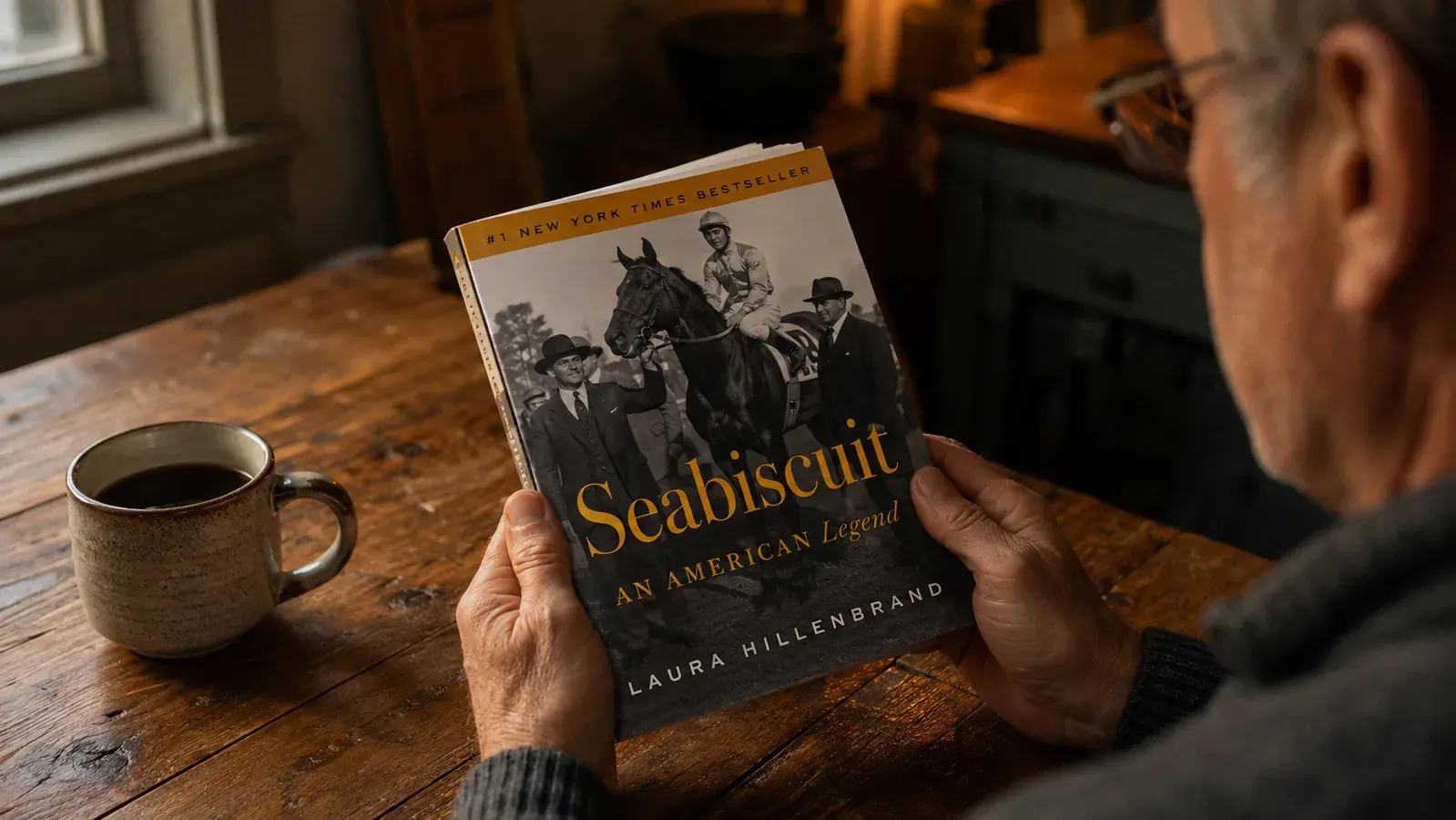
Start with the horse, because the horse is the whole argument. Seabiscuit was small, with a crooked leg and a famously lazy streak, the grandson of Man o' War who had been sold down the ladder and mocked at every turn because nobody believed he could run. Hillenbrand opens with him galloping along a California morning with fog on the track, and she hooks you before the first chapter closes. She writes nonfiction the way other people write novels, in scenes you can see. That is the rarest skill in sports history, and it is on every page.
Then there are the three men around him. Charles Howard, who came west with nothing and made a fortune selling cars. Tom Smith, the quiet horse breaker who had been written off himself and saw something in the little horse that nobody else could see. Red Pollard, the failed boxer turned jockey who read poetry to himself and to the horse in the barn. Hillenbrand weaves three broken arcs into one perfect one, and the sport she teaches along the way, the claiming races, the handicap weights, the long rail rides between tracks, is explained so plainly that a reader who has never set foot at a racecourse will follow every race. Her footnotes alone are a rabbit hole I have fallen happily into twice.
And the payoff is real. The 1938 match race at Pimlico between Seabiscuit and War Admiral was the biggest story in American sport that autumn, front page news everywhere, a two-horse race that stopped the country. Hillenbrand writes it as one long held breath. I re-read those thirty pages every couple of years and they still tighten my chest. If the story you want is about one creature and three men who refused to give up on him, this is the book, full stop. It is the tighter, more compactly built of the two, the one you can finish in a week of evenings, and on sheer craft it may be the better written.
It is also the deeper portrait of its own small circle. Because Hillenbrand narrows the lens the way she does, she can spend a whole quiet section on what it meant for these three men to find each other at all, men whom the decade had otherwise written off. The book stays with you as a story about rescue as much as a story about winning, which is why it keeps turning up in the hands of readers who do not care one way or another about horse racing when they start it.
I have bought Seabiscuit four times over the years: twice for myself, once for my brother in Ohio, and once for a nephew who had never watched a race in his life. All four copies got read to the last page.
Where The Boys in the Boat Wins
Here is what Brown gives you that Hillenbrand does not: the whole world. The Boys in the Boat opens in the rainy working-class Northwest of the 1930s and carries you across the Atlantic to the 1936 Berlin Olympics and the heart of Nazi Germany. The crew is made up of nine boys from logging camps and hardscrabble farms, and among them is Joe Rantz, who was left to fend for himself at fifteen and survived on windfall blackberries before he found the rowing shell that saved him. Brown makes you mourn for each of them in turn, then love them as a unit. That sweep is something no single-horse story can reach for.
The team is the point of this book, in a way no single-athlete narrative can manage. Rowing is the sport where nine men must move as one body, and Brown turns that physical fact into a meditation on brotherhood. Along the way he gives you George Pocock, the legendary boat builder, whose quiet maxims the boys carry into the Olympic final, and he gives you the race itself, rowed in a cold Berlin rain while Hitler watches from the stands. The last sprint is one of the finest passages in all of sports writing, and it earns its place because Brown has spent four hundred pages showing you why it matters.
The crossover reach is real, too. Look at which of these two books turns up on high school reading lists and book club tables, and The Boys in the Boat wins by a wide margin. It is the book people press on a neighbor who swears they do not read sports books, and it works. Hillenbrand writes in bright, sharp scenes. Brown's hand is gentler and more patient, closer to a grandfather telling the story properly before the kids go to sleep, and there is a strong case that for the brand-new sports history reader, Brown is the safer recommendation because his subject matter carries him.
The political weight is the other edge, and it belongs entirely to Brown. When the boys row in front of Hitler, every stroke carries a meaning the racehorses never had to carry. A century from now, readers will still be able to feel what it meant for nine Americans to row past the dictator's box in 1936, and Brown lets that landing sit rather than forcing it. That is a dimension of history, and a moral gravity, that Seabiscuit simply never attempts, and it is the single honest reason a reader who loves world history rather than sport should reach for Brown's book first.
The purest underdog story in American sport, in your hand by the weekend
Seabiscuit is the book I reach for when I want the lamp on and a story that ends the right way. Ballantine keeps it in paperback, and today's price is almost always the lower of the two books on this page.
Amazon Check Today's Price on Amazon →
What These Two Books Share
Before you decide, it is worth saying what they share, because the honest answer to the comparison is that both books belong in the hands of anyone who reads sports history for the story rather than the score. Both are built on reporting you can trust. Hillenbrand spent years in the archives, and her note section is its own kind of treasure. Brown did the same, and both writers turn that research into narrative that reads like a novel. Neither one leans on statistics to carry the weight. Both are really about people who had nothing and refused to accept it, and both have been read by millions for exactly that reason.
The two books also share the same relationship to their films, and it is worth naming because the movies confuse the choice. Seabiscuit became the 2003 film with Tobey Maguire and Jeff Bridges, and The Boys in the Boat became a 2023 film directed by George Clooney. Both movies are good enough that I understand the temptation to call it a day at the credit roll. Here is what the films cannot give you: the hundred small scenes Hillenbrand built from letters and race charts, the texture of a claiming race, the years Smith spent breaking mustangs; the winter Brown spent putting you inside a shell on open water just after dawn. The movies hand you the ending. The books hand you the reasons the ending mattered, and that is the whole difference.
And both books handled their decade honestly, which is the thing that makes them worth rereading. Nobody in either one is spared the Depression's ordinary cruelties. Men lose businesses, families pull apart, good people go hungry and keep going. The hope in both stories is earned precisely because the hardship around it is real, which is what separates these two from the hundred lesser sports histories stacked in the bargain bins. Neither writer flatters the past, and both books are better for it. Radio is the quiet heart of both narratives, the one thing a whole family gathered around at night, and it is how both the horse and the crew became names that crossed the country in a single afternoon.
Who Should Buy Which
Buy Seabiscuit first if you want one unforgettable horse, a small cast you will quote at dinner, and the tightest, most compact story of the two. Buy The Boys in the Boat first if you want the Depression on a bigger stage, with nine heroes and the weight of world history behind them. Neither choice is wrong. The only real mistake is assuming that one of them makes the other unnecessary. They answer different hungers, and a reader who loves one will almost always go on to love the other.
As a gift, I think about it this way. For my older brother, who used to spend Saturday afternoons at the track with his father-in-law, Seabiscuit. For my niece, just out of college, who reads everything and has never watched a sport in her life, The Boys in the Boat. If the person you have in mind already loves the world of racing, or loves a pure lost-cause story, Hillenbrand's book is the one. If the person insists they do not read sports books, Brown's is the one that wins them over. The comparison is not about which book is better. It is about which story fits which reader, and both of these are among the best American sports has ever produced.
And if you can manage it, the long answer is both. They are both modestly priced paperbacks at today's prices, they both get read twice, and they sit together on a shelf the way mismatched great books always do. But if a single copy is coming home tonight, the one I reach for first is still Seabiscuit. It is the more compact and more perfectly built story, and the Ballantine paperback sits open in the hand exactly the way an evening book should.
Give the great underdog its due tonight
Seabiscuit has spent two decades as the book people press on each other, and it has not lost a step. Ballantine's paperback is the copy I keep buying as gifts, and today's price is worth checking before the evening ends.
Amazon Check Today's Price on Amazon →