

I was thirteen when Larry Bird and Magic Johnson met in the 1979 NCAA title game, and I have carried that afternoon around ever since. Michigan State versus Indiana State was the first basketball game my father and I ever watched on purpose, the first one we argued about, and the first one that ended with him telling me to remember what I had just seen. So When The Game Was Ours had a long head start with me. I was already going to trust a book that let these two tell their own story.
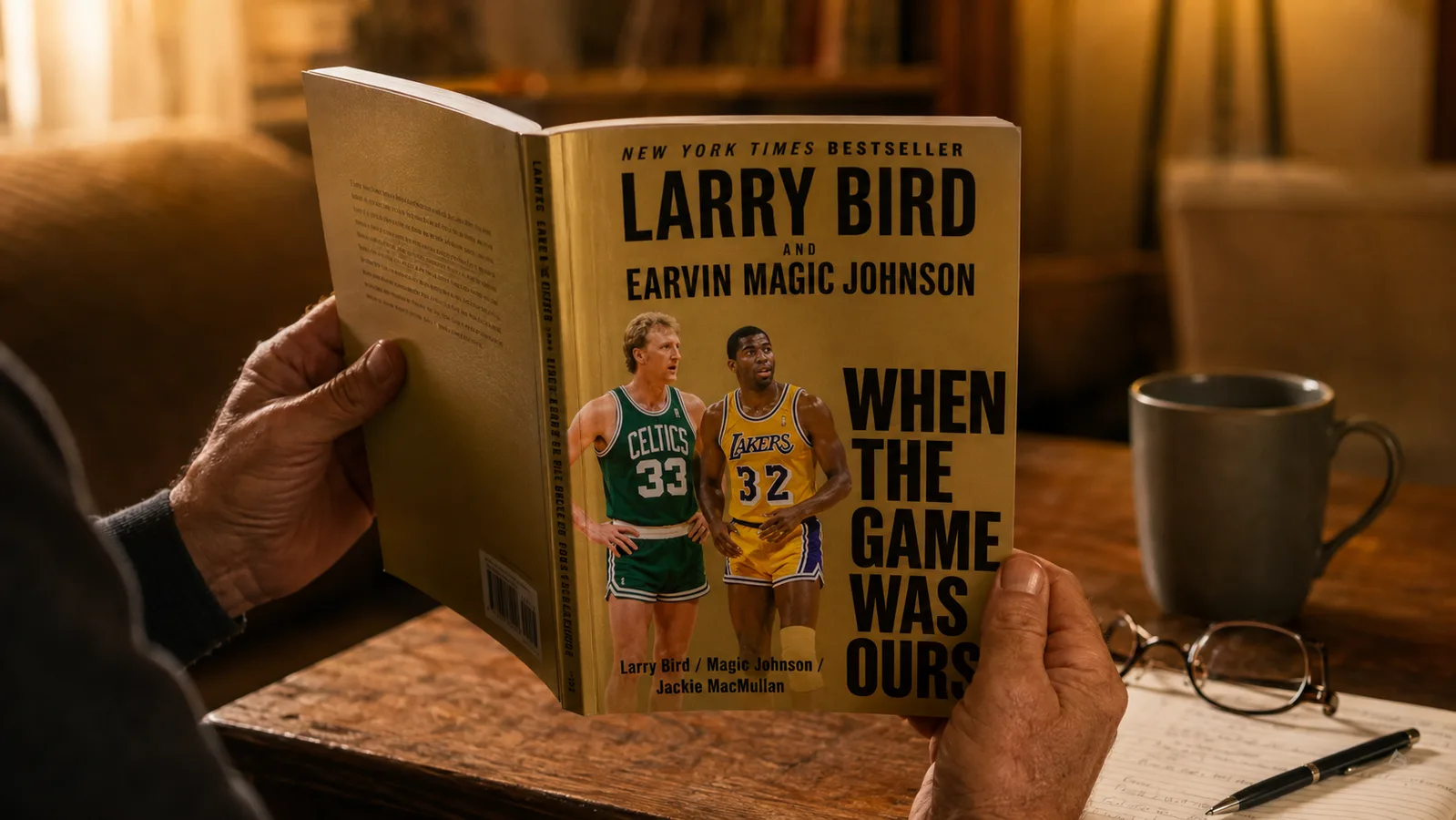
And that is exactly what it is. Jackie MacMullan, whose reporting I knew from years of following the sport, brings the interviews and the discipline of the Boston Globe, and Bird and Magic bring the memory. The result sits in a strange and valuable place. It is not a biography written from the outside, and it is not a scrapbook of old clippings. It is a conversation, an intimate memoir told in two voices with her stitching it together, and for anyone who lived through the eighties it feels like sitting in the room while two old rivals finally tell the whole thing.
The Quick Verdict
A genuinely moving two-voice memoir of the greatest rivalry in basketball history, best loved for the feeling of being there, not as a strict season-by-season record of the league.
Amazon Check Today's Price →Revisit the Rivalry You Thought You Knew
When The Game Was Ours is the closest any of us will get to sitting across from Bird and Magic while they talk it all out. See today's price on Amazon and decide if it earns a place on your shelf.
Amazon Check Today's Price on Amazon →How I Read It
I did not read it in one sitting, and I am glad I did not. I read it the way I read the good history books, a chapter or two most nights after dinner when the house got quiet. The first half, which carries Bird and Magic from their small towns through college and into the early rivalry years, went fast because it reads like a novel. I kept turning pages to get to the next famous game.
The second half slowed me down, and mostly that is to its credit. The chapters around Magic's HIV announcement, and the years after, are the ones you will not finish in one night. I kept putting the book down after them, not because the writing flagged but because it got heavy. I had forgotten how raw those days were, and the book does not let you forget. Two men in their fifties could have sanded the rough edges off their own memory, and they do not.
I also read it with a small stack of stat pages beside me, because an honest reader of a book like this should own up to checking it. That habit is worth keeping, and I will explain why in a moment, because it is the single thing the celebratory reviews never mention.
What the Two-Voice Format Actually Gets You
The thing nobody can copy is the contrast between the two men on the page. Bird is blunt, dry, a little bit cutting, still the small-town kid who refuses to be impressed by anything. Magic is warm, generous, theatrical, forever telling you why everyone he ever played with was wonderful. Put them on the same page and you get something a single-narrator biography can never produce: the same game, the same moment, remembered two completely different ways.
The 1984 Finals get the best of this. Bird remembers the chess, the angles, the way he read what the defense was doing a possession early. Magic remembers the theater, the stage, the joy of the biggest stage basketball had to offer. Both are describing the same series and it practically becomes two different sports. That dissonance, far from being a flaw, is the entire point. The history here is not a single settled record. It is two men's remembered truth laid side by side, and much of the pleasure is watching those truths refuse to line up.
The two voices stay distinct even on the page, and you get a sense within a few pages of which man is talking before the text tells you. Bird's sentences come out short and flat, Magic's run long and generous. MacMullan does not overdress either one, and that restraint is what makes it feel like you are eavesdropping on a real conversation instead of reading a book.
Where the Memoir Leaves Gaps
Here is the honest part that most of the glowing reviews leave out. This is a memoir, which means it is told from memory, and memory decades later is a slippery thing. Dates go fuzzy. Single-game details get half-remembered. Both men are telling you what they feel they lived, not what a game log will confirm, and they would be the first to admit it. Bird in particular is candid that he does not recall chunks of his own career with any precision. That is not a knock on the book. It is a warning about what you are holding.
It is also a very narrow slice of the NBA. This is Bird's and Magic's story, and everything else gets compressed to make room. The other great teams of the eighties, the league's money troubles, the drug-era scandals that touched the sport, all of it looms large only as it brushes against the two men at the center. If what you want from a basketball history is a fair, complete account of the entire league, this is not that book, and handing someone this expecting it to be that is how you set them up for a letdown.
That is why I kept a stack of stats alongside my reading. The book is superb at capturing the feeling and the character of the rivalry, and much less reliable as a record of exactly who scored what in which game on which date. Read it for the people. Check the numbers if the numbers matter to you. It does not pretend to be an almanac, and it is not the worse for it. It is simply asking you to meet it on its own terms.
The clearest example of what I mean is that neither man tries to keep a running box score. Bird will describe a particular playoff game with all the feeling of it intact and leave the exact point total vague, and Magic will do the same from the other side, and the two accounts will not always agree on who scored when. That is not a malfunction in the editing. It is the honest architecture of memory, which keeps the important thing, the emotion and the meaning, and quietly drops the number. A fan who wants to reconstruct a series from this book alone will come up a few points short. A reader who came for the men behind the games will be exactly where they need to be.
What Nobody Tells You About the Read
Nobody mentions how the pacing shifts partway through. The early chapters, the two small towns and the long roads to college and the pros, move like a movie. Then comes the long middle, the season-by-season march of the rivalry, and for a stretch it becomes a series of recaps, one famous game after another, some of which you will skim if you are not devoted to every box score from 1984 to 1987. I did not mind it, because I read for the voices and the context around each game, but a reader here for the friendship may hit a slow patch and should know to push through it.
It also repays a second reading far more than most sports books do. The first time through you are chasing the game results and the plot. The second time, with the outcome settled, you finally notice the small stuff: how Bird talks about his own stubbornness as a defense mechanism, how Magic keeps steering every memory back to how much he loved the moment. Those lines are what make this a book rather than a long magazine feature you read once and forget.
I should own up to something else. I bought this one as a gift first and read my copy second, which tells you where I had landed before I even opened it, and that is how most readers will meet it. It is the sort of book that sits on a table and gets picked up again, and it holds up to that better than most because you never need to read it straight through to enjoy it. You can open it at almost any of the championship years and be lost inside a few pages later. That flexibility is worth knowing, because it means the book works for the casual reader who would never finish a strict season-by-season history.
What I Liked
- Two genuine, unfiltered voices, Bird's bluntness against Magic's warmth
- The arc from the 1979 college game to the Dream Team reads like great fiction
- MacMullan's journalism keeps it grounded and moving at a good pace
- Outstanding on the rivalry years and the famous games that defined them
- Repays a second reading, which most sports books do not
Where It Falls Short
- Both men recall from decades-old memory, so dates and details blur
- Not complete NBA history, the wider league and era get compressed
- The long middle runs into stretches of heavy game-by-game recaps
- Readers who want strict records and stats should look elsewhere
That the two men who spent a decade trying to humiliate each other could sit together forty years later and laugh about it tells you more about sports than any box score.

The Rivalry That Became Friendship
The years of the rivalry, roughly 1984 through 1987, are where the book earns its reputation. Bird's Celtics and Magic's Lakers met for the title in three of those four seasons, and MacMullan captures that era beautifully, the two teams chasing each other all year and then meeting on the biggest stage. Each game felt like a referendum on the rival philosophies, and on a league that badly needed this rivalry.
The 1984 Finals are the hinge, and they get the space they deserve because they genuinely changed the league. Bird's Celtics took it in seven after a legendary Game 5 in the Boston Garden heat, and Magic's Lakers had led the series two games to one before it slipped away. Reading the two men on those games now, you feel the season as it happened, the way every possession was freighted with a whole year of buildup, rather than as a tidy outcome. That is the book at its strongest, and it is worth slowing down for these chapters even if the pace elsewhere had you skimming.
And then the friendship. The book has to walk a careful line, because neither man wants to look soft and neither wants to pretend the old hatred was anything less than real. By the time it reaches the 1992 Dream Team and the two of them sharing the floor in their last great years, the shift reads as earned rather than sentimental. That arc is why I ended up recommending this book to everyone in my family who remembers the eighties, and why I keep a copy by my chair.
The chapter around Magic's announcement, and the quiet way Bird talks about it, is worth the price of the book on its own. Two men who had spent a career beating each other, meeting in a city, both stripped of the old excuse to keep pretending they were only rivals. It is the moment the whole book has been moving toward, and MacMullan gives it the room it needs instead of rushing past it. It is the section that converts readers who do not care about basketball into readers who care about these two men.
How MacMullan Keeps Two Men Honest
The book's other quiet strength is what Jackie MacMullan does with the moments the two men would rather glide past. The drug-era suspicions that hung over the league, the early tensions inside both franchises, the parts of the later seasons neither man presents as a proud highlight, she lets them sit, nudges, clarifies, and moves on. She is not a stage manager or a cheerleader. She is there to keep two famous and powerful men honest, and the best proof is that both come out looking more human rather than less.
That is the part no highlight reel and no box score can ever give you. The healthiest way to read this book is to trust the feelings it produces and to treat the finer details as what they are, recollections offered decades later by men with no intention of doctoring them. That honest bargain, a memoir willing to tell you it is a memoir, is exactly why I keep recommending it even after flagging the gaps.
Who This Is For
If you lived through the eighties and watched any of it, even on a small fuzzy television in a kitchen like mine, this book is for you. If you grew up hearing your parents argue about whether Bird or Magic was better and never understood why, this is for you. If you love a well-told sports history that is really a story about two men growing from enemies into friends, this is for you. And it is the ideal book to press into the hands of a family member who claims they are not much for reading, because it reads like two old friends talking, which is a far lower wall to climb.
I also think it is a fine first NBA history for someone new to the era. You do not need prior knowledge to follow it, because the book does the quiet work of explaining who these two teams were and why the rivalry mattered while you are being entertained. You will come out understanding the eighties NBA far better than you went in, even though it never once sets out to teach. That is the mark of the best history writing.
Who Should Skip It
If you want a complete, impartial, fact-checked history of the entire NBA in the eighties, look elsewhere, because that is not what this is and you will find yourself frustrated by the gaps. If you need exact figures and dates you can trust without checking, you will spend a lot of time with an almanac open. And if you never cared much about Bird and Magic in the first place, this book will probably not convert you, because its entire engine is your existing attachment to those two men.
Judge It Honestly for Yourself
The honest verdict: When The Game Was Ours is not a complete history of the NBA, and it does not pretend to be. It is a warm, vivid, two-voice memoir, and on those terms it is superb. See today's price and find out whether it earns a spot on your shelf.
Amazon Check Today's Price on Amazon →