

For six years the same paperback sat on a shelf in my study with the spine unbroken, and I had a hundred reasons not to open it. My sister read Laura Hillenbrand's Seabiscuit in two nights and talked about it for a month. A retired history teacher I play chess with called it the finest American biography he had read in a decade. And I, a man in his late fifties who reads history every evening in the same leather chair, kept reaching for something else. Part of it was the title. I am not a racing man. I have never placed a bet, I could not tell you a furlong from a finish line, and a horse in a movie has never once moved me. What finally broke the delay was a rainy week in March and the stubborn realization that five trusted readers could not all be wrong. If a book that plain and that widely praised had been a fraud, at least one of those people would have caught it, and none of them are the sort to be fooled by a sticker.
The honest part I did not expect was that Seabiscuit is not really about the horse, and everyone who loves the book quietly knows it. It is a history of the American Depression told through a small, crooked-legged thoroughbred and the four people who carried him: the mechanic who made a fortune selling cars, the mustang breaker who studied horses the way scholars study texts, the half-blind jockey who would not quit, and the horse himself. It is also, and this is the part the praise skips, a book with genuine slow stretches in the middle where the reporting outweighs the story. I finished it a different reader than the one who started it. I finished it convinced that praising it straight through without naming those patches is a disservice to the person about to hand over money for it. So here is the review I wish someone had given me before page one, the one that tells you both what makes it great and exactly where you might set it down before the ending makes you pick it back up.
The Quick Verdict
One of the great American sports histories, built on reporting you will not believe, with two or three slow patches in the middle that the ending pays for in full.
Amazon Check Today's Price →Start with the horse everyone misjudged
The Ballantine Reader's Circle edition is the paperback most readers buy, and it earns its spot on any sports history shelf. See today's price on Amazon and decide for yourself.
Amazon Check Today's Price on Amazon →How I've Used It
I read it over four weeks, a chapter an evening, in the brown chair by the reading lamp. That pace matters, and I recommend it. The first hundred pages run fast because they are mostly character work: Howard, who lost his son on a road he had campaigned to build; Smith, who could settle a wild mustang with a glance and a curry comb; Pollard, a prairie kid with a fractured family who kept taking rides no sane jockey would accept. Each of them could carry a book on his own, and Hillenbrand gives them room to breathe before she ever lets the horse change their lives.
Somewhere around a third of the way in, the season by season walk through the race calendar begins, and my pace honestly slowed. I set the book down for two nights running. I picked it back up only because Pollard had just lost most of the sight in his right eye to that horse's hoof, and I needed to know what happened to him next. That is the trick Hillenbrand works on you: she makes the humans so vivid that you read through the slow parts for their sake, and by the time the match race with War Admiral arrives, you are gripping the arm of the chair and losing sleep. I remember turning the final pages well past midnight and having to remind myself that I already knew how the race ended, because the telling made the known outcome feel genuinely uncertain.
Since then I have read it twice, bought three copies, and pressed it on five people. One for my brother because he lived through hard times himself, one for a nephew who works weekends at a feed store, one that stays on the shelf so the original copy can keep its fringe of notes. I also watched the 2003 film once, after the book, and the book wins by the same margin Seabiscuit won that day: the film has to drop the era, and the era is half the point. The book never rushes, and that patience is precisely what the movie cannot afford to give you.
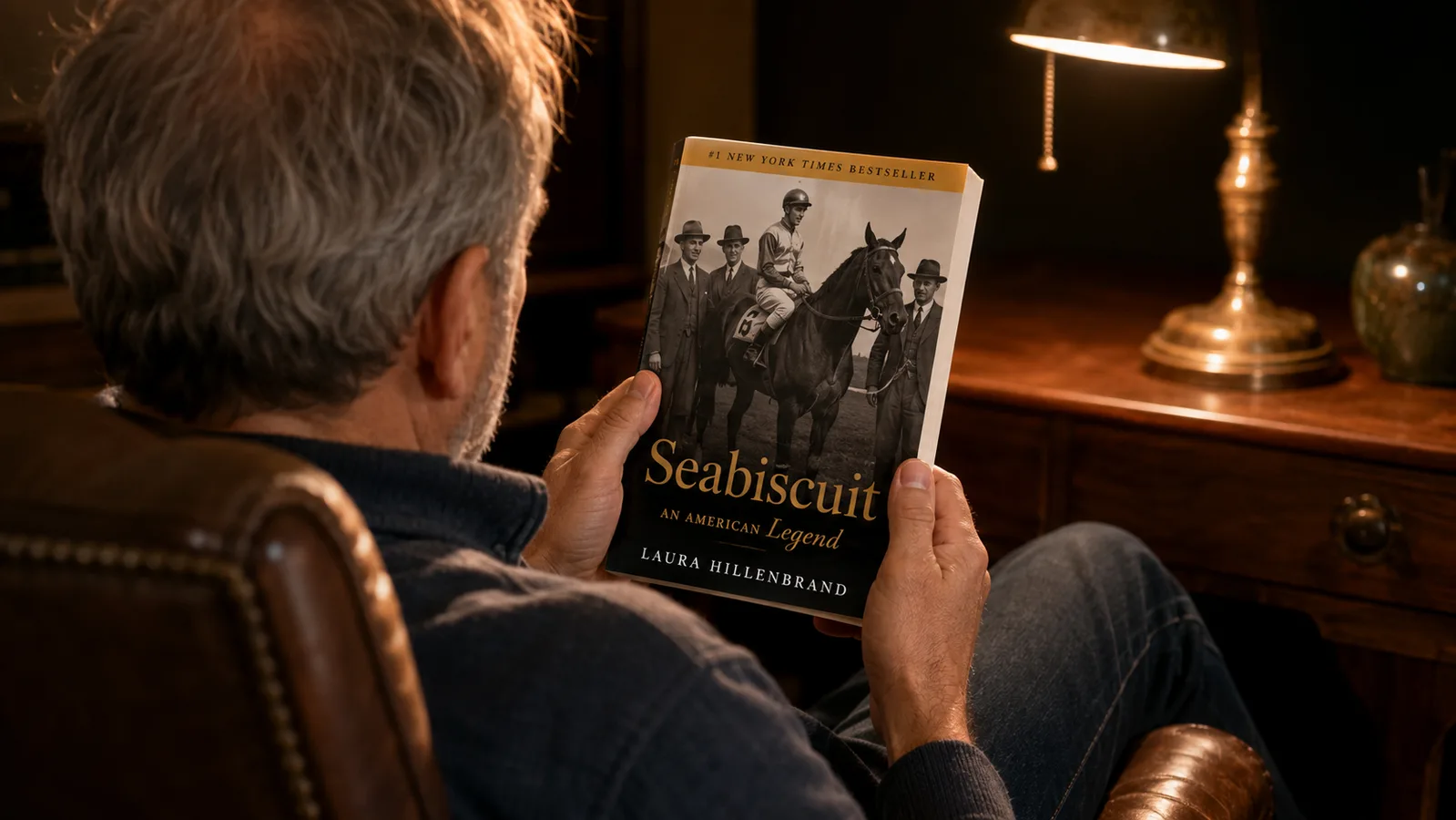
The Book the Praise Gets Wrong Before You Even Open It
The bookstores file Seabiscuit under horses, and that is a marketing accident that has misled a generation of buyers. The real subject is America in the 1930s. Hillenbrand spends her pages inside California, the migrant camps, the packing houses, the radios lit up in every kitchen, the election-year politics, the racing commissions fighting over a sport that had been chased nearly out of existence. Against that backdrop she sets a castoff horse with crooked legs, and she does not once explain why the country cared. She lets you feel the arithmetic yourself. A country that had watched its banks fail and its factories go dark did not need an essay about symbolism. It needed one small thing that kept winning.
This is the first thing nobody tells you. Buy it as a book about the Depression and you will be delighted by the second chapter. Buy it expecting a tidy underdog animal story and you will find yourself studying handicap weights and turf conditions and the economics of a breeding operation, and you will wonder how you got there. There is nothing wrong with the tangents. They are why the book is great. But know what you are buying before it arrives, because the gap between what the shelf label promises and what the pages actually deliver is the single most common reason readers report bouncing off it.
The other thing the praise skips is that this is a history book with no invented dialogue. Every quotation in the volume comes from a letter, an interview, or a newspaper account, and Hillenbrand has published her notes so the curious can chase the trail themselves. That may sound like a dry virtue, but it is the difference between a legend and a documented story. When you reach the end you have been told a true thing, not a tall one, and for readers who care about that distinction it changes the whole experience.
A nation that had lost everything watched a crooked-legged animal refuse to lose.
The Slow Middle Everybody Quietly Skips
Here is the honest part, the part this headline is about. From roughly a third of the way in until the match race at Pimlico, the book runs on race results. Hillenbrand was racing journalism before she wrote history, and the thoroughness shows on every page. She gives you the weights, the distances, the track conditions, the bloodlines of every also-ran, the names of seconds and thirds. For a racing man, and the book has converted more than a few, this is the deepest pleasure in the volume. For the ordinary reader who came for the horse, it is a wall. I say that plainly because every other review I read danced around it.
I want to be fair about the wall, because I nearly bounced off it. What carried me through was trust. By then she had stacked enough human detail that I believed every slow chapter was setting up the last act, the way a long middle of a chess game feeds the endgame. When Seabiscuit breaks down on the Santa Anita track and Pollard's leg shatters in the same ruined stretch of years, when the horse and the man are rebuilt for one last run at the race that had beaten them both, the patience pays out every cent. The book makes you earn its ending, and I finished grateful for the work. A friend who gave up around page 150 would not believe me, and I would not blame him. The book is honest about what it asks of you, but the sticker on the front does not warn you.
If you are the sort of reader who needs to know the payoff is coming, skip the race by race weeds on the first pass. The chapters about Howard, Smith, and Pollard stand alone without the intervening ledgers, and many readers have loved the book that way before circling back for the full read. The book survives both paths. That is unusual. Most histories are a single thing, built for a single kind of patience. This one is built for the patient reader and, if you know where to jump, for the impatient one too.
The Research Behind the Story Is the Real Story
The second thing nobody tells you is that Laura Hillenbrand wrote most of this from bed. Chronic fatigue syndrome had largely confined her, so the research happened by telephone and by reels of microfilm delivered to her apartment and spread across the bedroom floor. She could not stand at an archive. She could not walk a racetrack. She reconstructed races frame by frame from sixty-year-old newspapers and from the memories of people who had known a horse that had been dead for decades. The logistics alone should have made the book impossible, and instead they produced one of the most thoroughly sourced volumes in the genre.
The result is the strangest trick in modern sports writing: a heavily reported book where the reporting is invisible. Read the match race chapter and you will swear there was a camera along the rail, because the author has given you the exact positions, the exact strides, the exact gestures of George Woolf reaching for the whip. None of that is memory. All of it is reconstruction, dug out because her legs would not carry her to the source. I can think of no fairer sentence: it is a triumph of source work that reads like a novel.
The same reporter's discipline explains the book's coolness, which is the third thing nobody tells you. Hillenbrand almost never tells you how to feel. She does not moralize about what the horse meant. She reports the era, the wounds, and the wins in the same flat, exact tone and trusts you to supply the tears. Some readers call that distance. I call it respect. She treats the reader like an adult, which is rarer in this genre than it should be, and it is why the emotional moments land as hard as they do: you have not been led by the hand toward them.

You Will Remember Red Pollard, Not Just the Horse
If you have seen the film you know the shape of the story; if you have not, keep the book no more than an arm's length when Pollard is in a scene. The horse stepped on his right eye not long after they were paired, and the jockey rode on knowing, telling almost nobody, losing most of the sight in that eye while those around him kept betting on it. Hillenbrand sets that fact down without decoration and lets it gather weight on its own, which is exactly the trust the rest of the book has taught you to place in her.
Tom Smith may be the quietest major character in all of American sports history. He had been a mustang breaker on the northern plains, and he understood that the horse and he had both been judged too small, too plain, too much trouble. He attached a mongrel dog and a constant companion pony to Seabiscuit because the horse was a bundle of nerves wearing a hide, and the animals steadied him. Those small details are what I tell people at dinner years later, and they are the whole book in miniature.
Charles Howard is the engine, the salesman who understood showmanship and hope in equal parts and turned a losing castoff into a national headline. Put the four of them together and you have a Depression fable with not one invented scene in it, which is the deepest honesty the book offers: the story of Seabiscuit needed no embellishment, only a researcher stubborn enough to drag it out of the microfilm. That is the sentence I would put on the back cover if I were the publisher.
What Else I Considered
I keep a shelf of sports history and I judge every serious claim against its neighbors. The books people set beside Seabiscuit are its own film adaptation and the biographies of Secretariat, and both comparisons teach you something. The film is good, but it is a compression; the middle of the book, the part everyone calls slow, is exactly where the compression does the most damage because it is where the era lives. The Secretariat stories are about perfection. Seabiscuit is the opposite story, about imperfection refusing to lose, and that makes it the rarer book.
The closest cousin in my collection is Hillenbrand's own later book, Unbroken, the story of the airman and castaway Louis Zamperini. It is every bit the literary equal, and either will reward you. But for the reader who wants a true American legend and a book to give as a gift, Seabiscuit is the one I hand over first. I hand it first precisely to people who say they could not care less about horses, because it was never really about the horse.
What I Liked
- Reporting of near unimaginable depth, presented so plainly it reads like a novel
- The Depression-era history behind the horse is the best part, and it comes free for anyone who buys the book for the horse
- Disciplined, unsentimental prose that treats the reader like an adult
- A reliable gift book; a compact paperback, easy to hold in a chair, ready for any fan of good history
- Roughly 4,700 reader ratings, a 4.6 average, and the long-running consensus is earned
Where It Falls Short
- The middle third is a wall of race-by-race detail if you came for story rather than turf history
- The author's coolness can read as emotional distance; she never tells you when to cry
- It demands evenings, not one-sitting weekends; even I set it down twice
Who This Is For
Buy it if you love history with a human heartbeat and have never once watched a race. Buy it if you are the person whose family always hands them the sports books, or if you need one reliable gift for a parent who lived through hard times and still remembers radios in every kitchen. Buy it if a book that makes you earn its ending sounds like a feature and not a complaint. You are exactly the reader this one was written for. I would also hand it to anyone who has ever called themselves a reader of American history and quietly admitted they have never finished a sports book. This is the one that breaks that streak.
Who Should Skip It
Skip it if you need your sports narrative tight enough for a single sitting, because this one is patient by design. Skip it if you cannot abide an author who holds emotion at arm's length and makes you do the feeling. Skip it if you bounced off the film years ago and have decided the story is not yours. And one honest caveat for the serious horse-history crowd: a handful of turf writers have quibbled with specific race details in her account over the years, which is normal in this kind of reconstruction but worth knowing before you cite it in an argument. None of those quibbles has ever touched the heart of the book, but the careful reader deserves to know they exist.
The book that changed how I read sports history
There is a reason this paperback has outlasted most novels on the shelf. Today's price on Amazon is small money against a book you will press into everyone's hands. It is the rare gift that gets re-gifted forward for a generation.
Amazon Check Today's Price on Amazon →